Book & Author
Mohammed Abid Tufail: Sarfraz Nawaz in Figures — Complete Statistical Record
By Dr Ahmed S. Khan
Sarfraz Nawaz is remembered not just as a great fast bowler, but as a revolutionary figure whose invention of reverse swing shaped the careers of speed kings like Imran Khan, Wasim Akram and others.
Cricket fans will never forget one of the greatest bowling spells in Test history— the miracle that took place at the MCG on March 15, 1979. During the 1978–79 series in Melbourne, Pakistan faced certain defeat in their 100th Test. With Australia cruising at 305 for 3, Captain Mushtaq Mohammad placed his full faith in Sarfraz Nawaz.
What followed was an extraordinary display of fast bowling. Sarfraz claimed 9 wickets for 86runs, including a devastating burst of 7wickets for just 1 run. Australia collapsed from 305 for 3 to 310 all out, and Pakistan secured an improbable 71-run victory.
The television commentary capturing the final moments of Sarfraz’s historic achievement remains etched in the memories of cricket fans worldwide: "...12 overs remaining for play… Sarfraz is bowling the 36th over, he has 7 for 86… Sarfraz to Hogg… Hogg is struck on the pad. He is out LBW! The decision took a long time coming from umpire Bailhache, and Sarfraz has 8 for 86… with Hogg LBW for no score…Australia 9 for 310. A good delivery there by Sarfraz, another inswinger… the eighth wicket has fallen, and now there are four ducks on the board for Australia… and the next man in will be Alan Hurst... This one would have to go down as one of the all-time great performances in Test cricket history…Alan Hurst, who is batting this season… has not troubled the bowlers too much… is about to face his first ball from Sarfraz… the loud roars of the crowd… Sarfraz bowling his 36th over… has 8 for 86... And he is caught behind! A great catch by Wasim Bari! Hurst is out on the second ball for a duck! Sarfraz has finished with the magnificent figures of 9 for 86. Australia all out for 310 and Pakistan has won this Test match by 71 runs! Sarfraz Nawaz was the unbelievable hero of this game. From 3 for 305 to all out for 310—they lost 7 wickets for 5 runs! Mushtaq is carried off by the jubilant Pakistan supporters…"
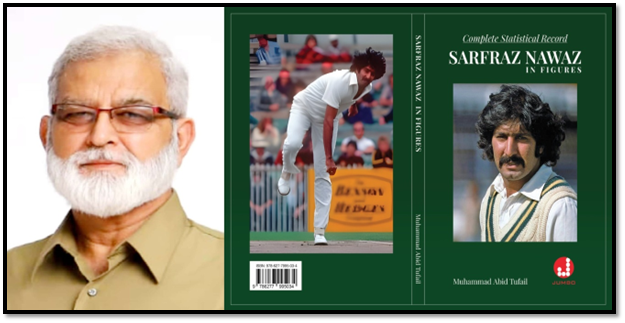
Sarfraz Nawaz in Figures: Complete Statistical Record by Mohammed Abid Tufail is a distinctive and meticulously crafted contribution to cricket literature — a data-driven tribute to excellence. At a time when most cricket literature prioritizes narrative storytelling or biographical profiles, the author takes a refreshingly valuable approach. This volume seeks to preserve the legacy of one of Pakistan’s most influential fast bowlers through an exhaustive, precise statistical record. The result is a work that exquisitely combines scholarship, passion, and archival precision, offering cricket lovers a definitive reference guide grounded in numbers.
Based in Karachi, Muhammad Abid Tufail holds a master’s degree in applied physics from the University of Karachi and previously served as a senior executive at the Oil & Gas Development Company Limited (OGDCL), Pakistan. An avid collector of cricket literature and memorabilia, he has built an extensive personal archive of over 3,000 books and historic cricket artifacts.
Describing his passion for the game in the preface, the author notes: “My own relationship with the game spans decades. I played cricket at club level in my youth, and when my playing days ended, my love for the game did not fade; instead, it deepened into a lasting passion. That passion found expression not only through reading cricket literature but also in building a substantial personal collection of cricket books and memorabilia, which today exceeds three thousand volumes and related artifacts.”
Reflecting on Sarfraz’s great contribution in form of reverse swing to cricket, the author observes: “While the elegance of batting and the artistry of bowling have always fascinated me, I have been equally drawn to the consistency demonstrated in the statistics. My interest in Pakistan cricket, particularly its rich and often under-documented past, has always been profound. I have consistently greeted and sought out books on Pakistan’s cricketers—past and present—yet I was struck by the relative absence of a comprehensive statistical work on one of the great cricketers of Pakistan’s own Sarfraz Nawaz. This was surprising, given that Sarfraz was not merely another fine fast bowler, but a larger-than-life character who has left an indelible mark on the game. Sarfraz’s enduring legacy lies in his revolutionary contribution to fast bowling—the invention and early mastery of reverse swing, which influenced generations of fast bowlers across the world. Such a personality deserved objective, and statistical validation of his career.”
Commenting on the nature of the book, the author states: “This book is, therefore, a labor of love. Its purpose is to provide cricket followers, researchers, and statisticians with a comprehensive and reliable statistical record covering Sarfraz’s performances across all major formats—First-Class cricket, Test matches, List A games, and One-Day Internationals—the book presents detailed chronological breakdown of his innings with summary of each season, records against specific oppositions, and assessments of his performances in both home and away conditions.”
Cricket fans vividly remember the iconic television commentary of prominent broadcasters Omar Kureshi, Iftikhar Ahmed, and Chishty Mujahid, who frequently depicted the classic field setting deployed for Sarfraz’s lethal spells: “Three slips, a short leg, a gully, Bari standing up... here comes Sarfraz... and the batsman is beaten by the reverse swing! That was close…”
In the book's foreword, Pakistan’s legendary former captain and wicketkeeper, Wasim Bari, recalls his long-standing on-field partnership with the maestro, observing: “ My combination with Sarfraz Nawaz, a champion fast bowler, was hailed as one of the most productive legacies in the history of Pakistan cricket. He was one of the kingpins of our attack and, as wicketkeeper, I played due role to the best of my abilities to bolster the team. Two of us formed a notable and highly effective bowler/wicketkeeper partnership for Pakistan in international cricket throughout the 1970s and onwards to the early 1980s. We were recognized as a key component for our outfit, often working in tandem to dismantle opposition batting lineups. We were credited to have brought about 38 dismissals together in Test cricket.”
Wasim Bari commenting on Safraz’s pioneering the reverse swing, notes: “Sarfraz, as we all know, pioneered the art of reverse swing in cricket and he possessed the elusive ability of moving the ball late rather prodigiously which made my wicket keeping job even more challenging. Thankfully, I was able to rise to the occasion most of the time which served as an encouragement to him to continue firing on all cylinders. It was a privilege to be one of his contemporaries. We toured together to several continents, and I was a witness to nearly all his sensational bowling spells for Pakistan, extending him total support with safe, reliable and sharp wicketkeeping. He was my deputy during the home series against England in 1977-78.”
One of the book’s central strengths lies in its ability to demonstrate how statistics can illuminate a player’s true impact. Sarfraz Nawaz’s significance in cricket history extends beyond his numbers; he is widely regarded as one of the pioneers of reverse swing, a technique that revolutionized fast bowling. The book brings together the raw data—wickets taken, averages achieved, performances across different conditions—and allows readers to appreciate how these figures underpin the narrative of innovation. In doing so, the book offers a compelling reminder that statistics are not merely numbers; they are a language through which sporting greatness can be understood and validated.
The book also serves as a corrective to the relative lack of detailed statistical documentation about some cricketing greats, particularly those from earlier eras. While modern cricketers often benefit from extensive digital databases and media coverage, players like Sarfraz Nawaz emerged in a time when record-keeping was less accessible and less systematically compiled. By bringing together dispersed records into a single coherent volume, the author fills an important gap in cricket scholarship. The book’s meticulous detail—covering matches, wickets, milestones, and season summaries—ensures that Sarfraz’s career is preserved with the accuracy and respect it deserves.
Though primarily known for his bowling, the author highlights that Sarfraz was also a highly capable lower-order batsman. Ironically, his finest batting display came during his final Test match against England at Lahore in March 1984.
During the first innings, Sarfraz put on a spectacular display of his wide range of strokes, anchoring an enthralling 161-run ninth-wicket partnership with skipper Zaheer Abbas. He fell just short of a maiden century—dismissed for a career-high 90 runs after an uncharacteristic lapse in judgment against part-time bowler Chris Smith. He followed this up with a crucial, match-saving knock in the second innings. During this farewell match, Sarfraz passed the 1,000-run milestone, fittingly completing the rare Test double of 1,000 runsand 100 wickets before hanging up his boots.
Another notable aspect of the book is its implicit narrative structure. Although primarily statistical, the compilation of data gradually reveals the arc of Sarfraz Nawaz’s career. Readers can trace his early promise, his rise to prominence, and the peak years during which he delivered match-defining performances, including his famous nine-wicket haul in Melbourne in 1979. The statistics, when arranged chronologically and contextually, tell a story of persistence, adaptability, and brilliance. This subtle storytelling through numbers is one of the book’s most admirable achievements.
However, the book’s focus on data may also be seen as a limitation for some readers. Those seeking a conventional biography—with detailed anecdotes, personal reflections, and dramatic narrative arcs—may find the text less engaging than narrative-driven accounts. While the author does provide contextual insights and brief commentary, the emphasis remains firmly on the statistical dimension of Sarfraz’s career. This makes the book more suited to readers with a specific interest in cricket analytics or historical documentation rather than casual fans looking for an easy read.
Moreover, the book is a testament to the author’s personal dedication. Compiling such a comprehensive record requires not only access to extensive sources but also a commitment to accuracy and detail. The precision with which the data is presented reflects years of research and a genuine passion for the subject. This passion is evident in the care taken to ensure that every figure, every record, and every milestone is accurately documented and contextualized.
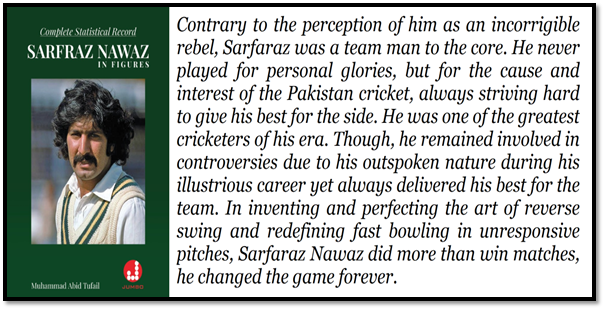
Contrary to his public perception as an incorrigible rebel, Sarfraz was a team man to the core. While his outspoken nature frequently mired his illustrious career in controversy, he never played for personal glory; his loyalty was always to the cause and interests of Pakistan cricket.
He was undeniably one of the greatest cricketers of his era, consistently giving his absolute best for the side. In inventing, perfecting, and pioneering the art of reverse swing—thereby re-defining fast bowling on unresponsive, flat pitches—Sarfraz Nawaz did far more than just win matches. He changed the game of cricket forever.
Sarfraz Nawaz in Figures — Complete Statistical Record stands as a significant and commendable addition to cricket literature. It is not merely a collection of numbers but a carefully constructed archive that preserves the legacy of a pioneering cricketer. By documenting Sarfraz Nawaz’s achievements with such rigor and clarity, the author has ensured that the legacy of this remarkable cricketer will endure—not only in memory but also in the precise and enduring language of statistics. The book fills an important gap in cricket literature and ensures that Sarfraz Nawaz’s contributions are recognized and preserved for future generations. This book is essential reading for all cricket enthusiasts.
(Dr Ahmed S. Khan — dr.a.s.khan@ieee.org — is a Fulbright Specialist Scholar.)