
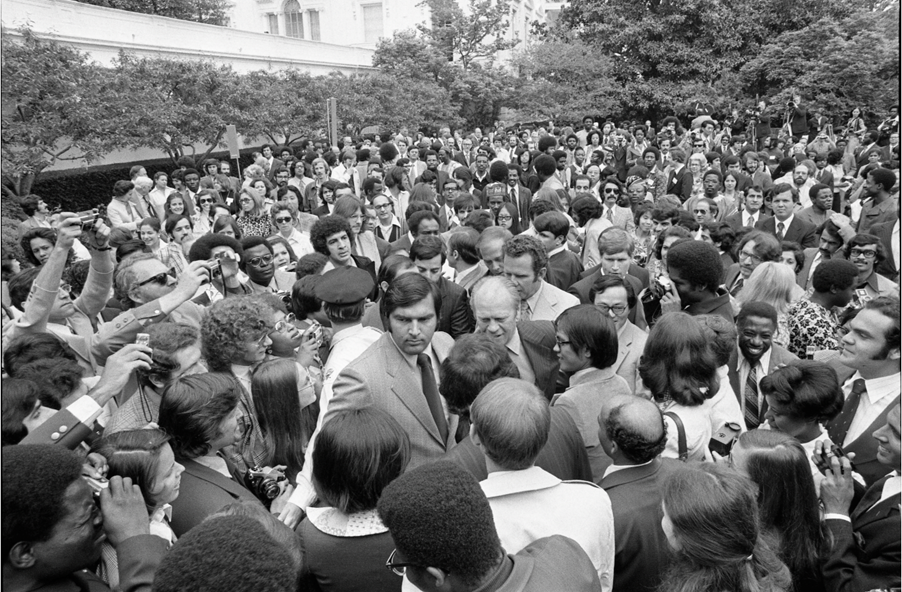
Author among students at the White House with President Ford, May 9, 1975
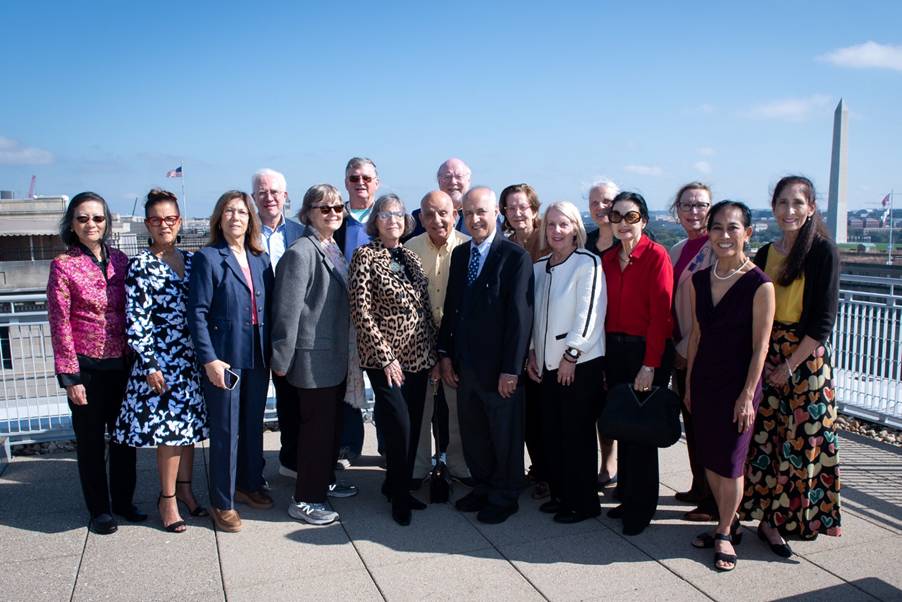
GWU class of 1976 with author in the center
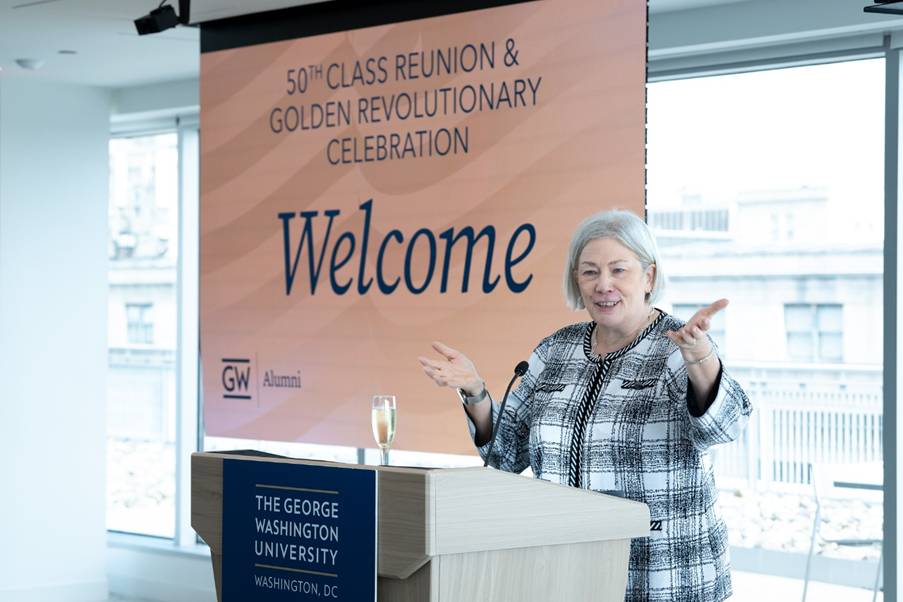
GWU President Ellen Granberg
"Get Serious and Get Some Skills": A Golden Anniversary Retrospective
By C. Naseer Ahmad
Washington, DC
On October 16, 2026, the seventh-floor terrace of the Elliott School of International Affairs offers one of those rare views that compels you to be quiet. Looking out, the marble spine of the Washington Monument pierces the capital’s sky, flanked by the stoic halls of government and history. Half a century ago, we walked these streets as restless young men and women. On this crisp afternoon, the Class of 1976 gathered to mark fifty years since graduation from The George Washington University.
I did not know the faces around me at first. Decades of living had painted silver into hair, carved lines into smiles, and brought several among us in wheelchairs. Yet the moment conversation began, time collapsed. There was no distance between strangers who had shared the same beginning. Fifty years had worn the body down in places, but it had not dimmed the curiosity in their eyes nor dampened the quiet fire that once brought each of us to Foggy Bottom.
President Ellen Granberg addressed our gathering with warmth, but it was the presentation that followed—narrated gently by the university archivist, Brigette Kamsler—that turned the room into a sanctuary of memory. As the projector hummed, an image appeared on the screen: the inauguration of the Metro rail at Foggy Bottom station. Suddenly, I was twenty-four again. I could feel the cold tile, hear the collective hush of passengers, and taste the wonder of boarding that inaugural train when the rides were free and the world felt brand-new.
Slide by slide, the presentation carried us through the fragile, vibrant years leading to the 1976 American Bicentennial. But on the private screen of my mind, another reel began to spin.
Every memory demanded I linger. I saw myself in 1974 beside my close friend Mushahid Hussein, then a graduate student across town at Georgetown. We had boarded a Greyhound bus, our pockets light and our spirits wide open, crossing endless miles of American highway toward Albuquerque, New Mexico, for the NAFSA (foreign student advisers’) conference. America was bruised back then, slowly healing from the trauma of Watergate and reaching for its moral compass. In President Gerald R. Ford, the nation witnessed what unadorned decency looked like. On a soft May morning in 1975, he welcomed a delegation of international students into the White House. My friend Mowahid Shah stood proudly at the head of our GW contingent, while Mushahid led Georgetown. We were young foreigners invited into the inner sanctum of an empire, treated not as spectators, but as respected guests.
That same era was marked by my own quiet terrors inside the classroom. For reasons I still struggle to explain, I chose to enroll in subjects that felt like sheer mountain faces, including thermodynamics. Most exam days, I was convinced disaster was imminent. When the passing marks arrived, I genuinely suspected the professor had handed back someone else’s paper. Around the same time, without formal training, I signed up for a course in database management systems—an early whisper of the digital revolution.
Why did I seek out things that threatened to defeat me? I suppose I was still hearing the voice of my grandmother. Years earlier, back in our dusty village of Kharian – District Gujrat, Pakistan, I was caught near the open water well after causing some boyish trouble. On that blistering summer afternoon, she cornered me, looked straight into my eyes, and barked, “Kid, get serious and get some skills.” I resented her fiercely for that dressing-down. For years, she was my least favorite elder. Yet her words became the secret rhythm beneath my footsteps: whenever life offered comfort, her voice nudged me toward the difficult, necessary task.
That persistence bore unexpected fruit. That same year, my mentor and lifelong friend, the late James J. Sakolosky, took a chance on me at the US Environmental Protection Agency. We were assigned to work on removing toxic lead from gasoline. It seemed like a technical, localized task at the time, yet the data and models assembled in those modest offices became the seeds of an international movement that eventually wiped leaded fuel from the globe. A boy from Kharian had helped clear the air for millions of children he would never meet.
The slides in the Elliott School Hall kept advancing, and so did the coordinates of my life.
One image shifted, and in my mind, I was half a mile beneath the earth’s crust in Zambia, knee-deep in freezing mine runoff, surveying copper deposits for the World Bank. Another click, and I was in the red Berber oasis of Ar-Rashidiya beneath the Atlas Mountains of Morocco, evaluating iron ore reserves. Then the sky opened: I was standing at NASA’s Kennedy Space Center beside my dear colleague Bob Raffaeli, and later taking the yoke of a small aircraft with David Bryden, banking over the sunlit water of the Banana River on my birthday.
Just a short walk from where our reunion lunch took place sat the National Press Club. There was a time when writing a simple technical report froze my hand in panic. Yet decades later, the blank page had become my companion—a place where I spent over twenty years contributing articles and essays, searching for words to bridge divided worlds.
One cannot speak of our generation without confronting the shadow of the Vietnam War. As the archivist turned to the mid-1970s, I remembered a freezing February evening inside the Dirksen Senate Office Building years later, commemorating two decades of normalized relations between Washington and Hanoi. Among the diplomats sat two Vietnam veterans who had both sought and lost the presidency of the United States. Their political ambitions had ended, but their dignity was intact. Senator John McCain stepped away from the surrounding dignitaries, walked to my table, and spent the evening speaking to me—not as a politician hunting for an audience, but as one wounded traveler asking honest questions of another.
That memory called up a private lunch with another veteran, a former Secretary of Defense. What stayed with me was not his power, but his habit of slipping a simple towel over his head to walk incognito among the ranks. He did not want stage-managed reports or stiff salutes; he wanted to listen to the whispers and burdens of young recruits while their guard was down. He knew that leadership begins by kneeling to hear the truth.
As the slides faded and the applause signaled the close of our reunion, I stood once more by the railing of the terrace. The autumn wind swept across the Potomac. Fifty years had passed in the space of a single breath.
I looked upward past the monument, into the vast, open expanse. In silence, I offered thanks to my parents, whose unheralded sacrifices across oceans gave my life its foundation. And quietly, with a full and grateful heart, I smiled at the spirit of my grandmother.
Look at me now, Baybayji (grandmother), I thought. I got serious. I learned the skills.
