Book & Author
Dr Aslam Abdullah: The Sharia — From Noah to Jesus and Muhammad
By Dr Ahmed S. Khan

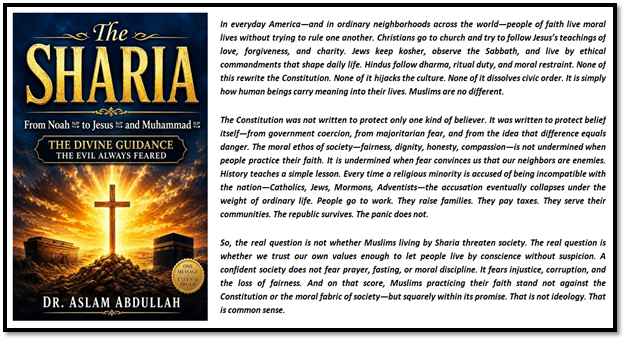
The Sharia — From Noah to Jesus and Muhammad (Kindle eBook) by Dr Aslam Abdullah explores Sharia not as a rigid political code or state-enforced legal system, but as a universal moral path and divine guidance for humanity. Examining the term through its root meaning and scriptural framework in the Qur'an, the book traces how the foundational principles of Sharia—centering on justice, human dignity, the sanctity of life, and personal accountability—unite the prophetic traditions of Noah, Abraham, Moses, Jesus, and Muhammad. By distinguishing timeless ethical guidance from historical human jurisprudence, the work reframes Sharia as a compass for personal integrity and social harmony rather than a threat to constitutional order.
Dr Aslam Abdullah is an American Muslim scholar, author, journalist, and interfaith educator whose work connects classical Islamic scholarship with contemporary civic and social issues. Born in India, he earned a doctorate in communication and journalism and has built a multifaceted career spanning academia, media, and community leadership across Asia, Europe, and North America.
Throughout his career, Dr Abdullah has played a significant role in advancing Muslim public discourse and interfaith engagement. As editor-in-chief of leading Muslim American publications, including The Minaret and the Muslim Observer, and as director of the Islamic Society of Nevada, he has devoted decades to promoting constructive dialogue among Muslims and members of diverse faith traditions. A prolific writer and sought-after speaker, he has authored numerous books and hundreds of articles exploring themes such as Islamic ethics, religious pluralism, democracy, and social justice.
The book is dedicated to misunderstood communities and principled Muslims and non-Muslims who reject fear, defend constitutional pluralism, and uphold equal justice. In the acknowledgement section the author thanks the scholars, journalists, and civil-rights advocates whose evidence-based work clarified public debate, as well as unsung defenders of religious liberty across all traditions. Gratitude is also extended to patient family and friends, and finally to intellectually honest readers willing to replace fear with understanding and substance.
In his foreword to The Sharia From Noah to Jesus and Muhammad, Dr Abdullah al-Ahsan frames the modern alarm over Sharia as a recurring democratic test between governing by evidence or by anxiety. Rather than answering political rhetoric with counter-rhetoric, the monograph evaluates whether constitutional and historical facts actually support fears of an imminent legal takeover.
Dr al-Ahsan highlights the book’s historical approach, noting that contemporary anti-Sharia sentiment mirrors past Western panics directed at Catholics, Latter-day Saints, Seventh-day Adventists, and Jehovah’s Witnesses—groups once suspected of divided loyalties before constitutional protections ultimately prevailed. Furthermore, he emphasizes that legal traditions do not develop in isolation; Western law itself evolved through centuries of cross-cultural exchange, sharing historical parallels with early Islamic judicial practices such as community participation and evidentiary deliberation.
Crucially, the book dismantles the myth of a Sharia takeover through constitutional arithmetic and institutional design, demonstrating that supermajority amendment requirements and civil law supremacy keep all religious practices—Christian, Jewish, or Islamic—firmly within constitutional bounds. Extending this analysis to Europe, the Anglosphere, and India, the text shows that anti-Sharia panics stem not from actual legal shifts, but from demographic changes, identity anxiety, and politicized religion.
Ultimately, Dr al-Ahsan underscores the book’s core democratic premise: in pluralistic societies, civil law governs while religious traditions guide voluntary moral life. Liberty is threatened not by minorities practicing their faith, but when majorities lose confidence in their own constitutional frameworks.
Framed by a Foreword, a Preface, an Epilogue, and a comprehensive Bibliography, the book is organized into twelve main sections. It opens by examining the voices behind the movement in Anti-Sharia Voices, before tracing its historical roots in From “Popish Plot” to “Sharia Threat” and exploring international parallels in Europe’s Mirror and The Global Map of the Anti-Sharia Narrative. The middle chapters analyze the mechanics of the controversy—covering The Arithmetic of Fear, What the “Anti-Sharia” Caucus Is, The Geography of America’s Anti-Sharia Moment, and States, Symbols, and Legislation. Finally, the book addresses the substantive legal and theological debates through Sharia on Trial: The Core Objections, A Qur’an- and Hadith-Based Rebuttal, and Anti-Sharia Laws in Practice, culminating in a concluding section (missing in table of contents) Chapter XII Sharia: What It Is — and What It Is Not, Chapter XIII Sharia: What It Really Means, and Chapter XIV: Sharia as Shared Moral Value Law, before the Epilogue.
The Preface establishes the book’s central inquiry into the political phenomenon of “anti-Sharia” activism across Western democracies. Observing that constitutional frameworks and civil law supremacy remain firmly intact in the United States and Europe, the author situates modern anxieties over Islam within a recurring historical pattern of moral panics previously directed at Catholics, Jews, and Mormons. Rather than advancing a theological argument or advocating religious public law, the text clarifies that Sharia operates within pluralistic societies as voluntary personal ethics—governing prayer, charity, and moral conduct. Ultimately, the Preface frames the book as an evidence-based investigation into how political fear is manufactured, mobilized, and codified into law, arguing that democratic resilience depends on institutional confidence rather than minority exclusion.
In Chapter I (Anti-Sharia Voices), the author examines the political, advocacy, and media networks in the United States and Europe that portray Sharia not as a religious tradition, but as an invading legal threat to Western civilization. Examples span from the US Sharia Free America Caucus and "counter-jihad" groups like ACT for America to European movements like Germany’s PEGIDA and Geert Wilders’s PVV.
While acknowledging that public anxieties over terrorism, economic shifts, and immigration are genuinely felt, the chapter demonstrates that the fear of a constitutional takeover is mathematically impossible. In the US, Muslims comprise roughly 1% of adults, and Article V of the Constitution requires steep two-thirds congressional and three-fourths state ratification supermajorities for amendment—rendering a stealth legal coup a political myth.
Instead, anti-Sharia rhetoric functions as an identity signal policing national belonging, blending anti-immigrant sentiment, far-right mobilization, and Christian nationalism. Situating this within American history, the author shows how Catholics, Latter-day Saints, and Seventh-day Adventists once faced identical accusations of "dual loyalty" and subversion before becoming fully integrated citizens. Ultimately, the chapter reframes the debate: the real question is not whether Sharia can overthrow democracy, but what uncertain majorities’ project onto visible minorities.
In Chapter II (From 'Popish Plot' to 'Sharia Threat’), the author traces how Western democracies repeatedly recycle the same moral panic against unfamiliar minorities, framing them as disloyal shadow governments poised to subvert the law. Beginning with 17th-century England’s fabricated "Popish Plot" and 19th-century American anti-Catholic nativism, the chapter examines parallel historical anxieties targeting Latter-day Saints (who faced mob violence), Seventh-day Adventists (opposed over Sabbath laws), Jehovah’s Witnesses (penalized over flag salutes prior to West Virginia v. Barnette), and Chinese immigrants excluded under ‘yellow peril’ fears.
Comparing these episodes to contemporary anti-Sharia rhetoric, the chapter underscores that US Muslims—comprising just 1% of adults alongside steep constitutional amendment supermajorities—pose no demographic or legal threat to constitutional order. Ultimately, history proves these panics unfounded: the true confrontation occurs in the political imagination over cultural belonging, while the republic grows stronger by protecting unpopular conscience.
In Chapter III (Europe’s Mirror), the author examines how anti-Sharia rhetoric in Europe—often framed as "Islamization"—stems from post-9/11 security shocks, immigration debates, and ethno-cultural national identities rather than actual legal threats. Analyzing France’s strict laïcité, Germany’s PEGIDA movement, populist politics in the Netherlands and Austria, and debates over voluntary religious arbitration in the UK, the chapter demonstrates that Muslims (comprising 5–10% of Western European populations) lack the numbers or legal mechanisms to alter constitutional orders. Echoing Europe’s historical panics over Jews and Catholics, the chapter argues that European democracies are tested not by pluralism, but by panic.
In Chapter IV (The Global 'Anti-Sharia' Narrative), the author demonstrates that anti-Sharia panics are geographically selective, driven not by Muslim population size but by contested national identities and politicized religion. While the narrative thrives in India—where Hindutva nationalism challenges Muslim personal law to enforce cultural uniformity—and is imported via Anglo-American media into Australia and New Zealand, it is absent in China, Russia, Japan, Latin America, and Africa due to different political structures, non-politicized religion, or indigenous Islamic history. Globally, anti-Sharia rhetoric reflects societal insecurity over demographic and cultural change rather than any genuine legal threat.
In Chapter V (The Arithmetic of Fear), the author demonstrates that moral panics over a "Sharia takeover" collapse when tested against demographic reality and constitutional design. With Muslims comprising roughly 1% of US adults—and 5% to 10% in Western Europe—steep supermajority amendment thresholds, entrenched courts, and institutional checks make constitutional capture impossible. Drawing parallels to past panics targeting Catholics, Mormons, Seventh-day Adventists, and Jews, the chapter argues that anti-Sharia fear is a projection of broader social and identity anxieties. Ultimately, democracies are endangered not by minorities practicing their faith, but when majorities abandon constitutional neutrality out of panic.
In Chapter VI (What is the 'Anti-Sharia' Caucus?), the author examines the Sharia Free America Caucus, an informal US House group launched in December 2025 by Representatives Chip Roy and Keith Self to campaign against perceived Islamic legal threats. While lacking independent legislative or enforcement authority, the caucuses promotes bills such as the Preserving a Sharia-Free America Act and Senate companion S. 3009 to bar Sharia-based rulings and restricts immigration for Sharia adherents. Constitutional scholars and civil-rights advocates warn these measures risk violating First Amendment religious protections, emphasizing that civil law is already supreme and Sharia functions peacefully as personal ethics.
In Chapter VII (The Geography of Anti-Sharia Moment), the author maps the political and regional landscape of anti-Sharia activism across the United States. Anchored heavily in conservative South and Sun Belt states—led by Texas and Florida, which account for nearly a third of the all-Republican Sharia Free America Caucus—the movement spans seventeen states in Congress and over forty state legislatures through "foreign law" bills. Tracing state-level statutes from Oklahoma’s struck-down 2010 ballot measure to neutral-sounding bans in states like Alabama, Kansas, and North Carolina, the chapter shows that anti-Sharia legislation stems not from courtroom necessity, but from cultural identity politics and religious demographics.
In Chapter IX (Sharia on Trial), the author systematically deconstructs the seven core objections raised by the Sharia Free America Caucus: constitutional incompatibility, parallel legal systems, women’s rights, religious freedom, national security, extremism, and cultural relativism.
In Chapter X (Rebuttal), the author systematically refutes the seven core anti-Sharia objections using primary Islamic sources—the Qur’an and Prophetic Hadith. Drawing on foundational principles such as non-compulsion in religion (2:256), the Prophet’s pluralistic Charter of Medina (Ṣaḥīfat al-Madīnah), women’s inheritance and marital consent rights, and strict prohibitions against extremism and collective suspicion, the chapter demonstrates that Sharia functions as voluntary personal ethics rather than coercive state law. By distinguishing authentic scriptural mandates for justice, covenant-keeping, and human dignity from authoritarian cultural distortions, the chapter concludes that Islamic ethical practice enriches, rather than threatens, constitutional pluralism.
In Chapter XI (Anti-Sharia Laws), the author analyzes the nationwide proliferation of state-level ‘foreign law bans’—largely modeled on David Yerushalmi’s "American Laws for American Courts" template—which prohibit courts from enforcing foreign or religious rules that conflict with constitutional rights. Examining enacted statutes and amendments across seven states—Alabama, Arizona, Kansas, Louisiana, Tennessee, South Dakota, and North Carolina—the chapter exposes a striking paradox: in every state, Muslims comprise roughly 1% or less of the population, and legislators failed to cite a single instance of Sharia overriding US courts.
In Chapter XII (Sharia: What It Is — and What It Is Not), the author contrasts polarized public portrayals of Sharia—amplified by over $42 million in anti-Sharia spending and a scarcity of accessible educational resources—with consensus definitions from Muslim American scholars, secular academics, and the Qur’an.
Rather than a rigid, totalitarian legal code seeking global domination, Sharia is defined as a dynamic ethical path governing personal worship, family life, and social responsibility, aimed at preserving life, religion, intellect, family, and property. The chapter highlights the crucial distinction between immutable divine guidance (Sharia) and fallible, historically contextual human interpretation (Fiqh), noting that secular scholarship likewise recognizes it as a diverse, multi-school tradition rather than a monolithic statute book. Grounded in Qur’anic mandates for freedom of conscience and non-coercion, Sharia aligns seamlessly with First Amendment liberties, ultimately serving as a test of America’s commitment to constitutional equality.
In Chapter XIII (Sharia: What It Really Means), the author defines Sharia literally as a "clear path"—a moral route for personal conduct rather than a state constitution or criminal code. Examining key Qur’anic verses (45:18, 5:48, and 42:13), the chapter illustrates how Sharia represents the shared ethical spine uniting the Abrahamic prophets rather than a blueprint for political domination.
In Chapter XIV (Sharia as Shared Moral Law), the author challenges the assumption that Sharia is an alien political code, revealing it instead as the continuous moral inheritance uniting the Abrahamic prophets. Anchored in Qur’an 42:13, the chapter traces a shared ethical core across Noah (sanctity of life), Abraham (upright integrity), Moses (covenantal moral formation), Jesus (inward conscience and mercy), and Muhammad (justice and covenant-keeping). Comparing these prophetic principles directly with the US Constitution, the author demonstrates complete harmony—emphasizing that Muslims seek only the same constitutional liberty to practice personal ethics alongside, rather than above, civil law.
In the Epilogue (Common Sense, Common Ground, and the Ordinary Truth We Keep Forgetting), the author strips away political slogans and legal jargon to emphasize a simple truth: practicing one’s faith does not threaten constitutional order. Just as Christians, Jews, and Hindus live by daily moral traditions without subverting civic life, Muslims practice Sharia as a personal ethical compass—praying, fasting, giving charity, keeping promises, and dealing fairly with all neighbors. Drawing on history’s repeated vindication of once-suspected minorities, the Epilogue concludes that a confident republic fears injustice rather than prayer, and that Muslims living by conscience stand squarely within America’s constitutional promise.
The bibliography for the book comprises twenty-nine authoritative secondary and classical primary sources. It blends contemporary academic scholarship on Islamic law, human rights, and pluralism—featuring works by Kecia Ali, Wael Hallaq, Jasser Auda, and John L. Esposito—with foundational medieval texts such as Al-Bukhārī, Al-Ghazālī, and Ibn Qudāmah. While the entries follow Chicago Manual of Style guidelines, final publication requires minor formatting standardization, including italicizing book and journal titles, unifying typographic apostrophes, and correctly sorting classical Arabic authors alphabetically. Furthermore, strengthening the reference apparatus by reclassifying medieval jurists into primary sources and adding a dedicated section for US statutes, Supreme Court cases, Pew Research data, and scriptural translations will ensure complete academic rigor for the manuscript.
Despite its valuable theological insights, the book does not fully conform to traditional scholarly standards in several important respects. Rather than presenting a rigorously academic study, the author primarily approaches the subject as a corrective and pastoral guide aimed at countering Islamophobic rhetoric, which results in a less formal scholarly tone. The manuscript also lacks many of the features typically associated with academic scholarship, including extensive footnotes, in-text citations, engagement with historiographical debates, and sustained dialogue with relevant secondary literature.
Furthermore, the chapters are relatively brief, ranging from approximately 540 to 1,982 words across a total of 91 pages (19,999 words), which limits the depth of analysis in several areas. The manuscript would also benefit from a thorough review for spelling, grammar, and stylistic consistency. In addition, the table of contents is incomplete, as titles for Chapters XII, XIII, and XIV are missing. Finally, the absence of both footnotes and in-text references makes it difficult for readers to verify sources and evaluate the evidentiary basis of the author's arguments.
The Sharia — From Noah to Jesus and Muhammad offers meaningful theological reflections and a valuable response to common misconceptions about Islam. Best categorized as accessible public theology, its limited adherence to scholarly conventions prevents it from meeting the standards of a fully developed academic work.
(Dr Ahmed S. Khan — dr.a.s.khan@ieee.org— is a Fulbright Specialist Scholar)