
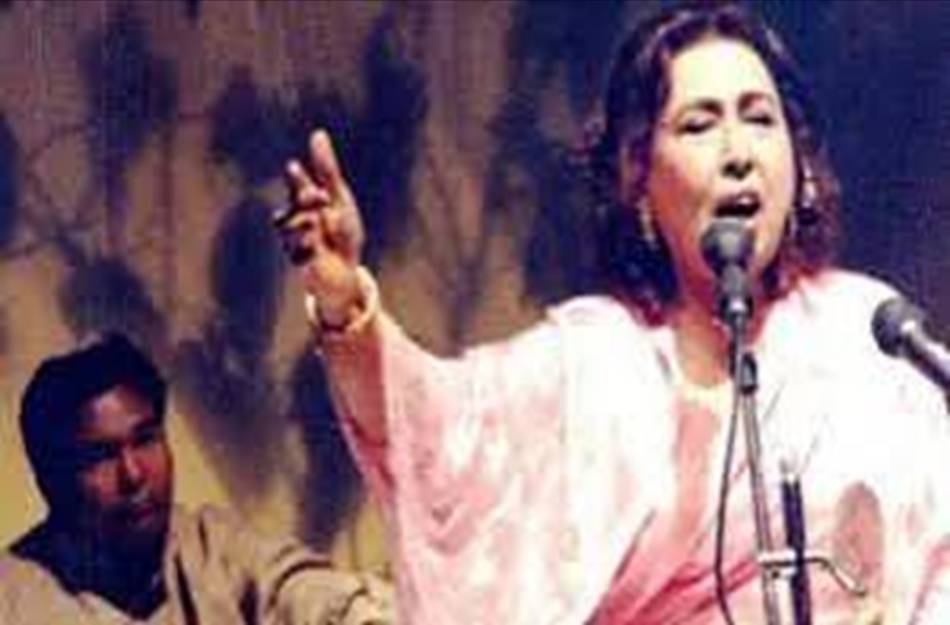
In Iqbal Bano’s rendition, a song of protest that seeks to unsettle the powerful and foretells their downfall is cased in a delicate, poised melody
Gen Z Adds ‘Hum Dekhenge’ to Its Protest Playlist
By TM Krishna
As protesters all over India demand the resignation of the chief election commissioner and the restoration of every citizen’s voting rights, I offer this musical note of solidarity.
For generations, Faiz Ahmed Faiz’s Hum Dekhenge has been an integral part of protests, a metaphor for resistance, justice and democracy, and since 2019 it has seeped into our wider national consciousness. While its history and lyrical depth is well known, the song’s musical cadence is less discussed. The gold standard for this song is without doubt the rendition by Iqbal Bano in her stirring protest against Zia-ul-Haq, and that is the basis of this piece.
Hum Dekhenge is not an activist’s chanting song, shrill in tonality, fast in tempo, with an un-decorative melody. It is simple yet nuanced in its flow and melodic direction. Iqbal Bano’s rendition is unusually slow, embedded with filigree work and subtle movements that allow the song to unfold evocatively.
The way Bano renders Woh din ke jiskaa vaada hai, with jiskaa meandering ever so slightly, followed by a stunning musical drop at vaada hai leading sharply to hum dekhenge is stunning. She follows that up with a tantalizing glide across the octave, sensuously singing the phrase jo lauh-e-azal me likha hai.
The equanimity in Bano’s rendition adds a political layer to the text. A song of protest that seeks to unsettle the powerful and foretells their downfall is cased in a delicate, poised melody. This aesthetically shifts agency from the bully to the determined protestor. The singer and listeners take control, dislodging the oppressor with understated surety and strength – a reminder most powerfully of Gandhi’s satyagraha.
There is another breathtaking moment in the song.
Hum mehkoomon ke paaon tale jab dharti dhad-dhad dhadkegi
When the earth’s beating, beating heart will pulsate beneath our broken feet.
Iqbal Bano cradles the words Hum mehkoomon ke rocking them gently as she moves to dharti where she nonchalantly extends the vowel “i” only to settle at the melodic imagery of the heartbeat as she utters the words dhad dhad dhadkegi.

This article first appeared in Scroll
This is a thoughtful and reflective song that questions. The dissipation of oppression and the inner seeking of freedom coalesce in it. And the melody mirrors this perfectly, finely balancing the dream of the promised day with the oneness of humanity. In Jana Gana Mana, hope emerges at the very end of the song when Tagore speaks of the sun rising from behind the eastern hills. In Hum Dekhenge, it is actualized in every verse.
For long, patriarchy has had an ironclad grip on this (Indian) nation. The protests of the past few months have been refreshing because of the creativity with which the young have targeted the powerful and their notions of machismo, with how they have met “chhappan inch” with “chhota bandar”. Their humor and irreverence have caught these self-indulgent politicians off-guard.
Hum Dekhenge is not a meme, but for generations its musical assurance and playfulness has done the same job: stripping the cloak off powerful narcissists. By subverting the protest music template, the song forces the listener to pay attention, sway to its tune, smile, rejoice and be collectively touched by its profundity. In Iqbal Bano’s voice Hum Dekhenge also becomes a feminist response.
The English translation of the song cited here is by Mustansir Dalvi .
TM Krishna is a leading vocalist in the Karnatik tradition and an author. His most recent book is We, the People of India: Decoding a Nation’s Symbols. This article was first published in Scroll . sapannews.com)
-----------------------------------------------------------------------------
Back to Pakistanlink Homepage
|
