Renowned Journalist, Author, Scholar and Chief Editor of Famous Urdu Digest, Altaf Husain Qureshi Passes away
By Dr A. Khan
Chicago, IL
Renowned veteran journalist, scholar, author, and editor-in-chief of the famous Urdu Digest, Altaf Hassan Qureshi, passed away in Lahore on Saturday, May 16, 2026, at the age of 94. His passing marks the end of a legendary era in South Asian Urdu journalism and intellectual discourse. His funeral prayers were offered the following day, May 17, 2026, at Jamia Ashrafia in Lahore.
Throughout his illustrious 65-year career, Qureshi witnessed and documented seismic historical events, spanning from the pre-partition era to the fall of Dhaka and the Afghan war, profoundly shaping public discourse through his columns in Daily Jang, analytical essays, and numerous books.
Born on March 3, 1932, in Sirsa, Haryana, British India, Qureshi was raised in a lower-middle-class Muslim family oriented toward intellectual pursuits. His youth was heavily molded by the complex communal dynamics of pre-partition India, where he experienced both the unifying cultural influence of a local Sufi shrine and the sting of religious biases from non-Muslim peers. The post-1945 RSS-linked riots and political shifts surrounding the Lahore Resolution deeply solidified his perspectives on identity and nationalism.
Following the 1947 Radcliffe Award, his family joined the mass exodus of over seven million Muslims fleeing violence. On November 2, 1947, they migrated from eastern Punjab to the newly formed dominion of Pakistan, navigating severe refugee camp hardships under the guidance of his elder brother, Dr Aijaz Hassan Qureshi. He arrived in Lahore on December 27, 1947.
Financial constraints prevented Qureshi from pursuing formal higher education beyond the secondary level. However, he built a profound intellectual foundation through self-directed learning at his school’s exceptional library in Sirsa. There, he immersed himself in history, theology, poetry, and novels, absorbing works by secular authors like Premchand alongside influential Muslim thinkers such as Maulana Abul Ala Maududi and Shibli Naumani. His dedication to learning was so fierce that, even amidst the escalating chaos of Partition, he prioritized packing scholarly books to prepare for the traditional Adib Alim examination, a resilience that ultimately channeled his talents into a lifelong passion for empirical journalism.
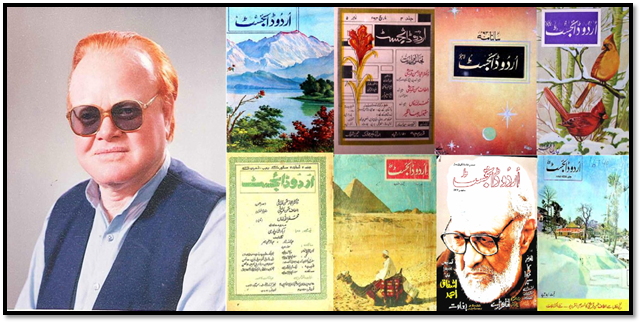
Following the creation of Pakistan, Altaf Hassan Qureshi and legendary novelist Ibn-e-Safi emerged as two monumental pioneers who revitalized and popularized the Urdu language for successive generations. While Ibn-e-Safi (1928–1980) revolutionized Urdu literature by authoring over 240 masterfully crafted spy thrillers across his Jasoosi Duniya and Imran Series universes, Qureshi revolutionized the print media landscape by launching Urdu Digest in Lahore in 1959. Modeled after the American Reader’s Digest, this pioneering publication transformed how Urdu was written, distributed, and consumed. By introducing a modern, family-friendly pocket format, Qureshi shifted public reading habits away from dense academic journals and cheap pulp fiction into mainstream household culture.
For more than half a century, Urdu Digest reigned as Pakistan's most widely read periodical, a staple at city bookstores and railway station stalls, famously keeping travelers’ company on long train journeys from Karachi to Lahore and Peshawar. Under Qureshi’s leadership as editor-in-chief since November 1960, the magazine served as a vital vehicle for language development. It enriched Urdu vocabulary by translating international literary masterpieces, scientific journals, historical essays, and psychological studies, proving the language's adaptability to modern concepts. Simultaneously, it kept the subcontinent's rich literary history alive by reprinting classics from masters like Saadat Hasan Manto and Krishan Chandar. Crucially, the publication bridged the geopolitical divide with India, maintaining a massive, dedicated readership among India's Urdu-speaking population by providing premium contemporary content in the traditional Urdu script. Through this strict standardization of elegant prose, Qureshi successfully elevated Urdu into a sophisticated medium for contemporary global thought.
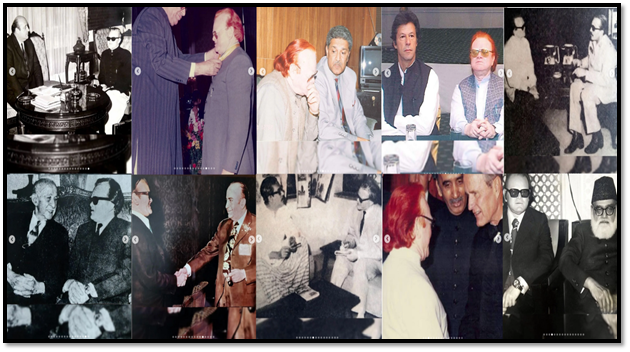
Beyond its literary contributions, Urdu Digest became a powerhouse for independent political analysis and empirical documentation. Qureshi prioritized firsthand sourcing, preserving crucial accounts of early constitutional and political developments that mainstream daily newspapers often overlooked. Over his six-decade career as an interviewer, he conducted extensive conversations with more than 200 prominent political leaders and intellectuals. Compiled in celebrated collections like Mulaqatein Kia Kia, these writings offer unfiltered insights into the decision-making processes and internal power dynamics of iconic figures such as Zulfiqar Ali Bhutto, Sheikh Mujibur Rahman, King Faisal of Saudi Arabia, and General Zia-ul-Haq.
Qureshi's books remain vital primary sources for Pakistan's major historical milestones. In Maen Ney Aine Banate Dekha, co-authored with Dr Anwar Hussain Siddiqui, he provided an invaluable contemporary account of the intense debates behind the framing of the 1973 Constitution. Similarly, Mashraqi Pakistan: Toota Hua Tara draws from his on-the-ground reporting and travel experiences to chronicle the political disintegration, ethnic grievances, and policy failures in East Pakistan after the 1965 war—failures that ultimately culminated in the 1971 creation of Bangladesh. Because short-sighted and ego-driven politicians and generals ignored his warnings and recommendations, the country faced a catastrophic breakup. Ultimately, Altaf Hassan Qureshi's rigorous archival depth and analytical commentary successfully bridge personal testimony with historical fact, countering selective state narratives and leaving behind an irreplaceable repository for future historians.
Altaf Husain Qureshi sahib is survived by five sons and four daughters.
May Allah SWT bless his soul and grant him the highest station in Janet ul Firdous for his dedicated service to Urdu and Pakistan. Ameen.