
Embassy of Pakistan Honors 149th Birthday of Allama Iqbal
By Elaine Pasquini
Washington, DC

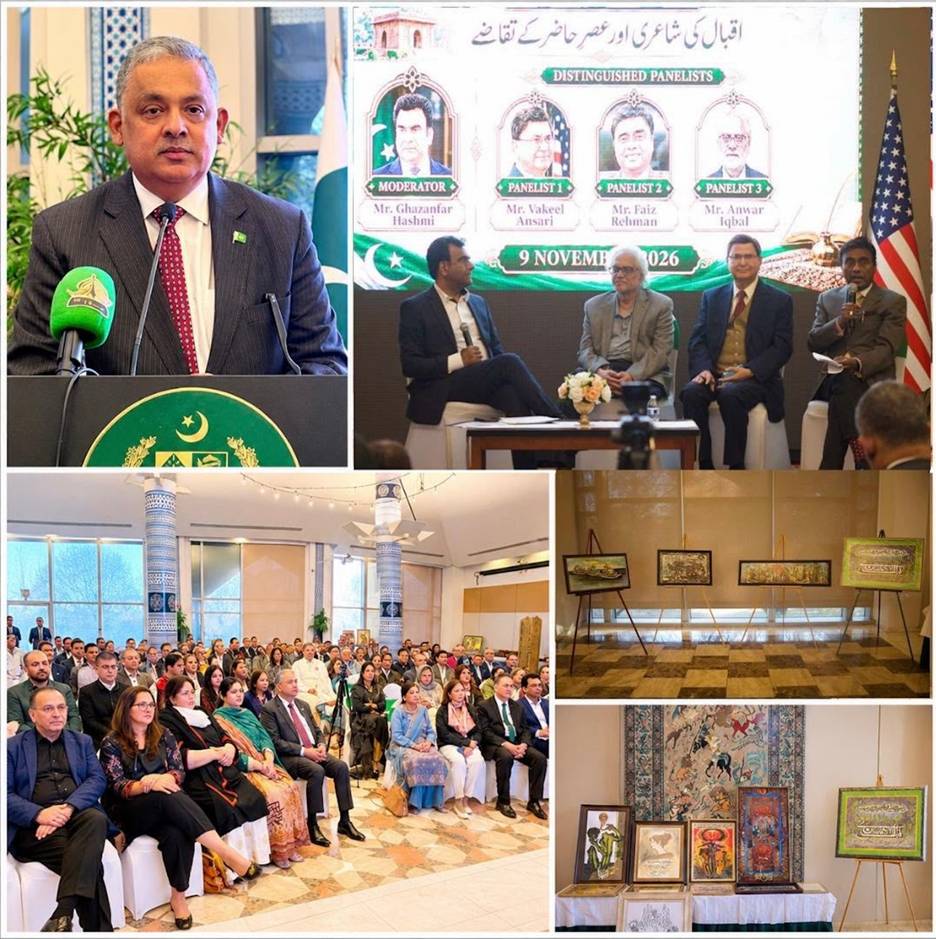
On November 9, 2026, the Embassy of Pakistan hosted a special reception celebrating the 149th birthday of Allama Muhammad Iqbal (1877-1938), the national poet of Pakistan. One of the preeminent scholars of Urdu and Persian literature from the Indo-Pakistan subcontinent, Allama Iqbal created poetry reflecting his philosophy as a political and social reformer who spelled out the idea of an independent homeland for the Muslims of the subcontinent.
In addition, an exhibition of the classical artwork of Syed Sadequain which highlighted his genius as a calligrapher, painter and poet was also on display at the embassy.
The event was organized in collaboration with the International Academy of Letters USA and Bazm-e-Harf-o-Sukhan, a prominent literary organization dedicated to promoting Urdu literature and poetry. The gathering drew a distinguished audience, including members of civil society, academicians, students, and representatives from the media.
During the ceremony, special messages from Pakistani Prime Minister Shehbaz Sharif, President Asif Ali Zardari and Deputy Prime Minister/Foreign Minister Ishaq Dar were read.
In his keynote address, Rizwan Saeed Sheikh, Ambassador of Pakistan to the United States, highlighted the profound intellectual significance of Allama Iqbal’s message that continues to inspire generations.
“The intellectual foundation of our national life is rooted in the thought of Iqbal, just as the leadership of the Quaid constitutes the political foundation of our national life,” Ambassador Sheikh stated.
Elaborating on the central focus of Iqbal’s poetry in relation to the conceptualization of Pakistan, the ambassador noted: “The way Iqbal sought to awaken the youth and the nation during his time effectively yielded the intellectual foundation of the Pakistan Movement.”
Ambassador Sheikh further underscored the concept of Khudi (Selfhood) and human nobility—one of the cardinal themes in Iqbal’s philosophy and poetic works.
“Within Iqbal’s vision of Khudi lies a self- realization and confidence,” he said. “It is taking cognizance of the rightful place as the crown of all creation.”
Calling for sustained engagement with Iqbal’s intellectual heritage, Ambassador Sheikh urged attendees to convey his timeless message to future generations for academic self-reliance, guidance, and new ideas.
“It marks a glowing chapter of our national history that we must celebrate and need to do a far better job at transfer of this lavish legacy to the future generations,” he added. “Our intellectual tradition is undoubtedly rich and worthy of carriage forward.”
The program also featured an engaging panel discussion titled “The Poetry of Iqbal and the Demands of the Contemporary Era,” where speakers emphasized how Iqbal’s philosophy resonates across eras to provide continuous guidance for contemporary challenges. Following the panel, a musical performance based on the poetry of Iqbal captivated the audience.
In his closing remarks, Ambassador Sheikh expressed his gratitude to all participants for joining the embassy in honoring Iqbal’s legacy and reiterated the importance of integrating his philosophy into practical life.
(Elaine Pasquini is a freelance journalist. Her reports appear in the Washington Report on Middle East Affairs and Nuze.Ink.)
