Revisiting Darussalam, Nazimabad, Once the Intellectual Capital of Pakistan-II: Human Stories from Karachi - VIII
By Dr Ahmed S. Khan
“You will yet be the glory of the East; would that I could come again, Karachi, to see you in your grandeur.”
— Sir Charles Napier, Governor of Sindh
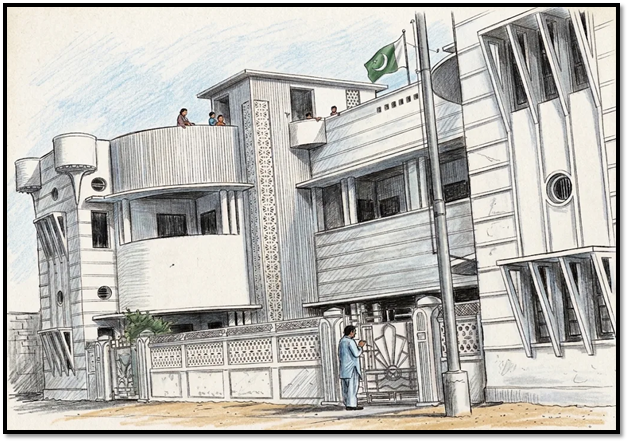
Darussalam — Our Family Home — Circa 1950s
Each year on August 14, family members assembled on the roof of Darussalam to celebrate Pakistan’s Independence Day with a traditional flag-hoisting ceremony
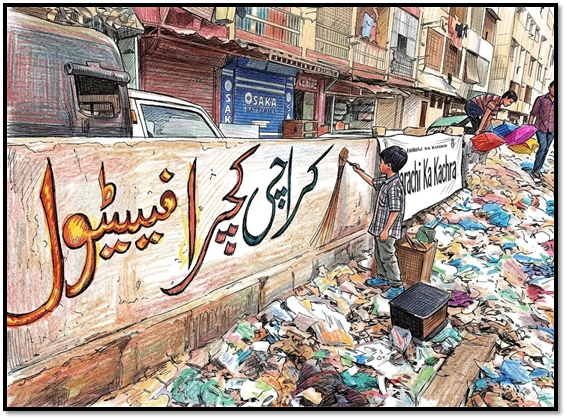
As my friend Irfan and I arrived at the site where my family home, "Darussalam," once stood—now replaced by an apartment building—I was saddened to see the decay of the surrounding structures, pools of sewage water, and heaps of garbage. It felt as though we had arrived in a Mohenjo-Daro of trash. The stark contrast made my mind race back to the past, visualizing the vibrant development of Darussalam and Nazimabad.
Literally meaning the "Abode of Peace," Darussalam was located in Nazimabad Block 3 (Nazimabad No. III-F-6/16) in Karachi, standing as a historic residence emblematic of the city's post-Partition intellectual, literary, and political heritage. Built during the 1950s when Nazimabad emerged as a premier suburb for middle-class and educated migrants (Muhajirs) from India, the house became closely associated with several prominent Pakistani figures.
Darussalam was one of the first houses constructed after the development of Nazimabad began. Its prominent, unique architectural shape and bright white appearance were easily visible from the Labella Naddi (stream), as the Lasbella Bridge had not yet been built. Located directly opposite Bus Stop No 1 on the road leading to Gole Market and the Eidgah ground, it sat in close proximity to Hamdard Laboratories.
Darussalam was built by Abdus Salam Khan Suri (1927–2024), a noted Pakistani civil servant, Pakistan Movement activist, and author of the memoir Mayri Zindagi Kay Jhurokay (Windows of My Life). In the 1950s, shortly after Nazimabad was planned and allotted to resettle migrants, Abdus Salam Khan acquired a 216-square-yard plot (III-F-6/16) for himself and a neighboring plot (III-F-6/15) for his elder brother, Akhter ul Islam Khan—who was posted in Ceylon and later in Singapore as a foreign service officer—in Nazimabad No III using House Building Finance Corporation loans. His father, Ali Ahmed Khan, dedicatedly supervised the construction of the house before tragically losing his sight due to a blunder by an eye surgeon.
The property was partitioned into four sections spanning ground and upper levels. Akhter ul Islam Khan allocated the upper portion of his plot (III-F-6/15) for his father's family to reside in, while the lower portion was rented out. Similarly, both the upper and lower sections of Abdus Salam Khan's property (III-F-6/16) were rented out. A portion of the rental income from these three portions was used to support the family, while the rest went toward repaying the loans for both plots.
Abdus Salam Khan later left Karachi after being selected through the Public Service Commission to serve in the Agriculture Department, first in Khairpur (1961–1962) and later in Hyderabad (1962–1972), before returning to Karachi (1978–1987), where he retired as Deputy Secretary of Agriculture.
Like many homes in Nazimabad during the 1950s and 1960s, Abdus Salam Khan’s household was deeply connected to Karachi's literary circles. When he married Akhter Begum in November 1955, the renowned Urdu poet Raghib Muradabadi penned the traditional wedding poem (sehrah) for the occasion. During the mid-1960s, celebrated Urdu poet and intellectual Iftikhar Arif lived directly across from Darussalam after migrating from Lucknow. According to literary accounts, Darussalam served as a well-known neighborhood landmark. In the evenings, Arif and his circle of friends would gather on the small bridge (pulliyah) across from Darussalam to chat, recite poetry, debate literature, and share their aspirations before Arif rose to national fame on PTV's Kasauti. Later in his career, when Iftikhar Arif was employed by BCCI for a London posting, his family rented a portion of Darussalam and resided there for a number of years.
During its golden era from the 1950s through the 1970s, Nazimabad Block III—the immediate vicinity of Darussalam—was arguably the cultural epicenter of Karachi. Living just streets away were towering figures of Pakistani arts, letters, and sports, including painter Sadequain, poet Josh Malihabadi, humorist Ibn-e-Insha, scholar Shan-ul-Haq Haqqee, Hakim Mohammed Said (whose Hamdard Laboratories stood nearby), and Test cricketers Hanif Mohammad and Zaheer Abbas. Darussalam stands in historical memoirs as a quintessential symbol of that era's upwardly mobile, culturally vibrant Karachi.
Religious and cultural gatherings were a vibrant part of home life. Milaad mahfils were frequently organized by my mother, attended by many prominent ladies of the neighborhood and from other blocks, such as Begum Zubairi and Begum Hafeez—a prominent Nazimabad No 4-based social worker and mother of the renowned journalist, scholar, and former ambassador Qutubuddin Aziz. Qawwali ( Sufi devotional singing) mahfils were also held at Darussalam, where the Sabri Brothers performed many times to celebrate children's Bismillah ceremonies and other family functions.
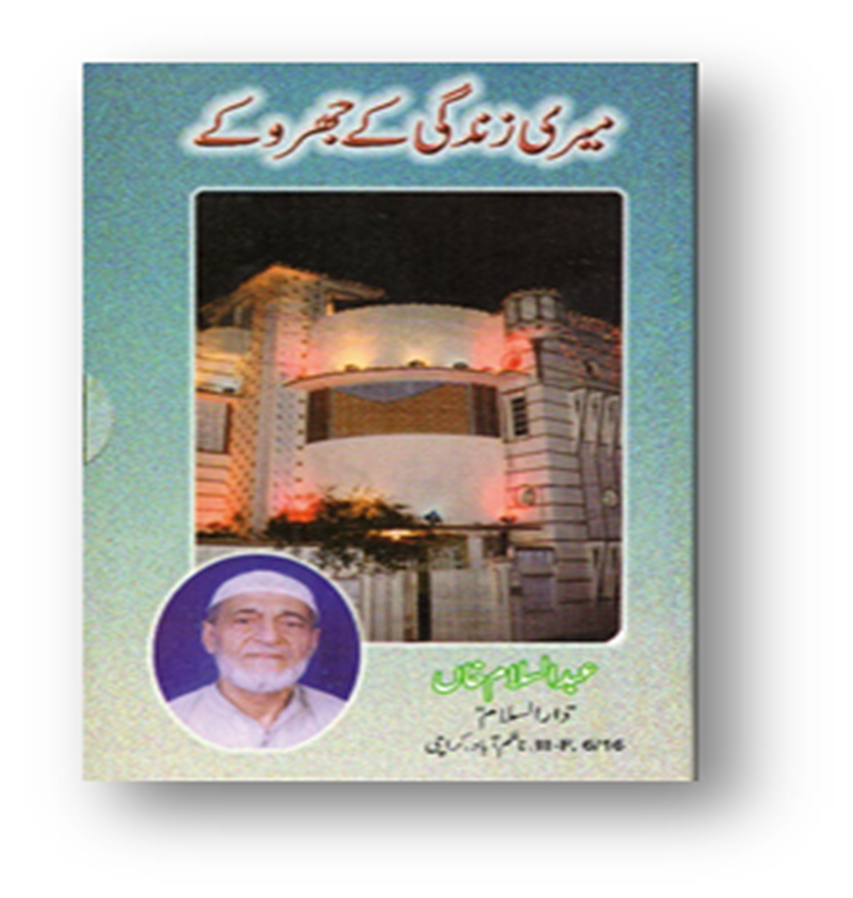
In his autobiography, Mayri Zindagi Kay Jhurokay (Windows of My Life), my father recounts the construction of our family home in Nazimabad, named "Darussalam":
"From August 17, 1947, to December 25, 1953, I lived in the refugee quarters with my parents and younger siblings. Until 1949–50, we occupied two quarters and made a decent living, but after my elder brother left for Ceylon (Sri Lanka) in 1951, we were reduced to a single two-room quarter. Facing this acute shortage of space, I became a member of the Pakistan Employees Cooperative Housing Society (PECHS) in hopes of acquiring land, though without success.
Around this time, the foundation was laid for Nazimabad—the first housing colony established in Karachi after the creation of Pakistan, named in honor of Prime Minister Khawaja Nazimuddin. I applied for plots in both my name and my elder brother's. I was allotted a 216-square-yard plot (III-F-6/16), for which a 50-year lease and registry were executed in my name starting January 1, 1951. Meanwhile, my elder brother, Akhter ul Islam Khan, who was still in Ceylon, was allotted a 212-square-yard plot in Block 1 near the Petrol Pump Chowrangi. Through the combined efforts of his father-in-law and me, we succeeded in having his allotment transferred to the plot immediately adjacent to mine, III-F-6/15.
Holding my brother's general power of attorney, I applied for construction loans from the House Building Finance Corporation (HBFC) for both of us. My loan was approved first, allowing us—under my father's supervision—to begin construction up to the plinth level on both plots in 1951. After overcoming a few initial hurdles, my brother's loan was also approved in 1953. Upon the completion of my double-story house in December 1953, our family moved to Nazimabad. At that stage, water was the only utility available; there was no electricity, drainage system, roads, or bridges. Only a handful of houses were under construction in Block F, making us among the very first pioneers to settle in the area.
It was a remarkably inexpensive era: a bag of cement cost just Rs 7, steel sold for Rs 7.50 per ton, and daily wages were Rs 2.50 to Rs 3 for a mason and Rs 1 to Rs 1.50 for a laborer. Because the newly built house exceeded our immediate needs, we rented out three portions at the modest rate of Rs 175 per month each. At the time of our move in December 1953, I was employed at the Cotton Board. Even after paying our monthly loan installments, we saved a few hundred rupees from the rental income, ensuring a very comfortable livelihood.
One interesting chapter in the history of Darussalam deserves special mention. From 1956 to 1958, the late father of General Pervez Musharraf, who later became President of Pakistan, was our tenant and lived on the ground floor of our home at III-F-6/16, Nazimabad. In 2000, concerning a personal matter, I wrote to General Musharraf and referred to his family's stay at Darussalam. He graciously responded, and a copy of his letter is included in this autobiography.”
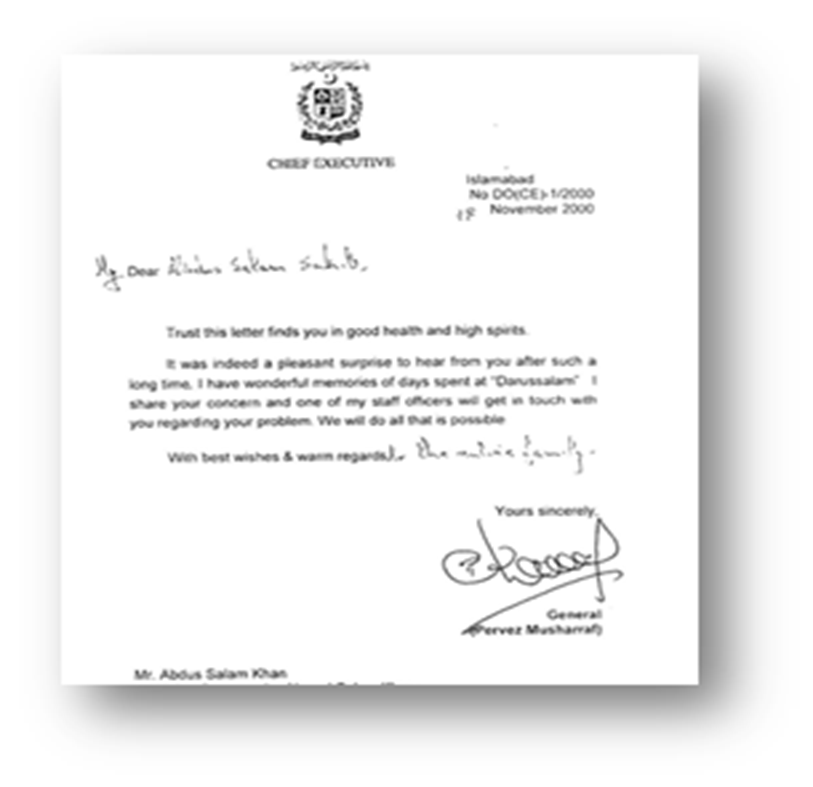
My mother cherished fond memories of Begum Zarin Musharraf's strong character and guidance. While living at Darussalam in Nazimabad, Zarin Aappa—as my mother affectionately called her, with Zarin Aappa addressing my mother in return as Chottee Bahoo—instilled strict discipline in her sons. During the week, parents and children were occupied with their respective jobs and schooling, but on weekends, Zarin Aappa ensured that every member of the household participated in morning house-cleaning chores before partaking in breakfast. Deeply attuned to each son's personality and aptitude, she guided her eldest son, Javed, toward the civil service, Pervez (whom she nicknamed Palloo) toward a military career, and her youngest son, Naved, toward medicine. The Musharraf family thoroughly enjoyed their time at Darussalam, and even fifty years later, whenever Javed and Pervez visited Karachi, they would return to Darussalam with immense nostalgia for the home where they spent their formative years.
Reflecting on the family's return to Karachi from Turkey in his autobiography, In the Line of Fire, General Pervez Musharraf notes: "In October 1956, when I was thirteen years old, we arrived back in Karachi… My father reported back to the foreign office… We found a house [Darussalam] in Nazimabad Block 3, one of many new settlements that had mushroomed after independence to accommodate millions who had fled India… My mother soon found another job [at Philips in SITE] … Our neighborhood, Nazimabad, was a tough place to live… A boy had to be street-smart to survive… I was one of the tough boys."
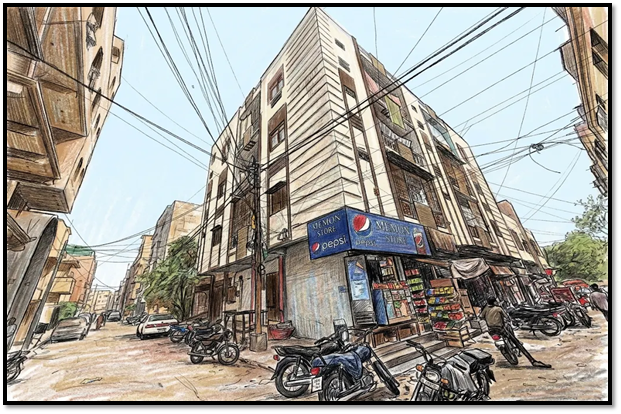
An apartment building now occupies the former site of Darussalam. After my parents migrated to the United States in 2000, the house was sold, and the new owner replaced it with a multi-story residential complex. Over the years, the surrounding neighborhood has also changed dramatically, evolving into a congested mix of auto repair shops and rapidly expanding commercial developments
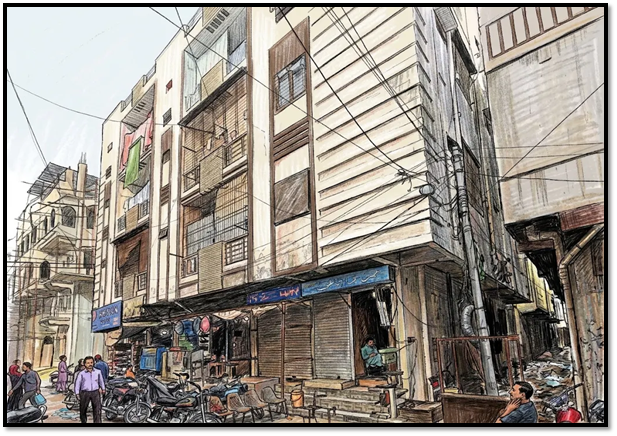
Nazimabad, once a remarkably clean neighborhood, now presents a stark contrast, with piles of garbage accumulating in its back alleys (gullies)
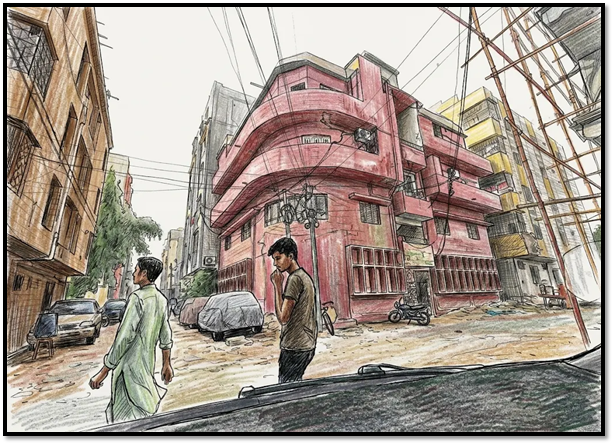
A view of the residential buildings surrounding the present location of Darussalam
Expounding further on the development and cultural significance of Nazimabad, my father writes: "In 1952, the government purchased this tract of land from a local landowner, Masti Khan Brohi, to resettle refugees, subdividing it into plots ranging from 120 to 2,000 square yards. The new residents hailed primarily from Lucknow, Delhi, Hyderabad (Deccan), Amroha, and parts of East Punjab, representing every walk of life—writers, poets, artists, thinkers, doctors, engineers, lawyers, and athletes. Many were pioneers and trailblazers in their respective fields, including Ibn-e-Insha, Riaz Farshori, Mohsin Bhopali, Sehba Akhtar, Aalia Imam, Azhar Nafees, Ibn-e-Safi, Aslam Farrukhi, Obaidullah Aleem, Majnoon Gorakhpuri, Ghulam Mohiuddin, Shakeel, Sangeeta, Kavita, Sajid Hasan, Saeed, Mazhar Ali, film producer Rizvi, Dr A. Q. Baqai, Dr Muhammad Ali Shah, Sadequain, Iqbal Mehdi, Justice Lari, Mukhtar Zaman, Mujahid Barelvi, Heshmatullah Lodhi, Mehdi Hassan, Salman Alvi, the Mohammad Brothers, Naseem-ul-Ghani, Intikhab Alam, Saleem Yusuf, Azeem Hafeez, Rizwan-uz-Zaman, Moeen Khan, General Pervez Musharraf, Mahmood Azam Farooqi, Qari Waheed Zafar, Shan-ul-Haq Haqqi, Masood Naqvi (President of Unicerin), Manzar Ayobi, Jamil Jalibi, Azhar Abbas Hashmi, and Jan Alam, among many others.
The neighborhood's famous Gole Market, home to the Star and Prince bakeries, served as our social hub. Its concrete culvert ledge—the pulliyah—was the true heart and soul of the market. Sitting there to eat felt as luxurious as riding in a Pajero; it melted away the fatigue of the entire day, and during curfews, it became the most coveted spot in the neighborhood. The local elders would gather on that ledge over cups of tea to pass the time and solve the problems of the world. Nearby was Sufi Sahib’s Hotel, a bustling tea house run by the cheerful Sufi Sahib, who bore a striking resemblance to Mirza Ghalib, while his son, Babu Tehra, could often be found flying kites. The local legends of our youth included Anwar Bhai, Talat Bhai, Mahmood Bhai, Sohail Bhai, Riaz Bhai, Zafar Bhai Test, Tariq Bhai (Kallay), Noshad Bhai Chhanga, Zaheer Bhai, Zia Bhai, Muzaffar Bhai, Qaiser Bhai, Bunny Bhai, Rony Bhai, Sunny Bhai, Sajid Bhai, and Buddha Khursheed. May Allah grant forgiveness to those among them who have passed away, Ameen. Gole Market held a central place in our lives, nurturing us like a parent; we must never forget it. Oh Allah (SWT), keep our Gole Market forever thriving, Ameen.
In the realm of sports, Nazimabad was second to none. National badminton champion Minhaj Ahmed first honed his skills on the street right outside his home, though cricket remained the true crown jewel of our neighborhood. All four Mohammad Brothers—Hanif, Wazir, Mushtaq, and Sadiq Ali—went on to represent Pakistan internationally, while Rais played first-class cricket. Sadiq Mohammad fondly recalls his days playing club cricket in Nazimabad. Right on the main street of Block 1, club owner Saadat Ali, Asif Iqbal, and Zaheer Abbas played together, drawing spectators from far and wide to witness matches whose quality rivaled English county cricket. The Pak Crescent team played near the Educational Board Office, while Zaheer Abbas lived just a street over, with Salahuddin Sallu and Intikhab Alam residing nearby. The National Cricket Club was renowned for its fast bowlers, whereas the Rizvia Society Diamond Cricket Club boasted a leg-spinner named Mahmood Hasan, who famously clean-bowled Hanif Mohammad. Few neighborhoods anywhere in the world—not even Lahore's Zaman Park—can claim such an extraordinary impact on cricket; the Nazimabad XI of the 1960s could have competed with any international Test side.
Beyond sports, Nazimabad was a vibrant cultural and intellectual center. The renowned Ghalib Library, housing 3,000 books and 375 literary magazines, was built by Habib Bank through the tireless supervision of Faiz Ahmed Faiz and Mirza Zafarul Hasan, who had previously collaborated to establish the Idara Yadgar-e-Ghalib. The library was further distinguished by its tin signage and interior murals painted by the legendary artist Sadequain. Eminent literary figures such as Ismat Chughtai, Sibte Hasan, Josh Malihabadi, Jilani Bano, and Safdar Jafari regularly graced its halls to deliver lectures. Meanwhile, for cinema enthusiasts, Nazimabad was nothing short of paradise, boasting numerous theaters where one could enjoy a film for just 6 annas in the general enclosure or one rupee for a box seat."
Through its pioneering residents, vibrant social institutions, sporting traditions, and rich cultural life, Nazimabad evolved into far more than a housing colony. It became one of Karachi's most dynamic and influential communities, leaving a lasting imprint on the social, intellectual, and cultural history of Pakistan.
(Continued Next Week)