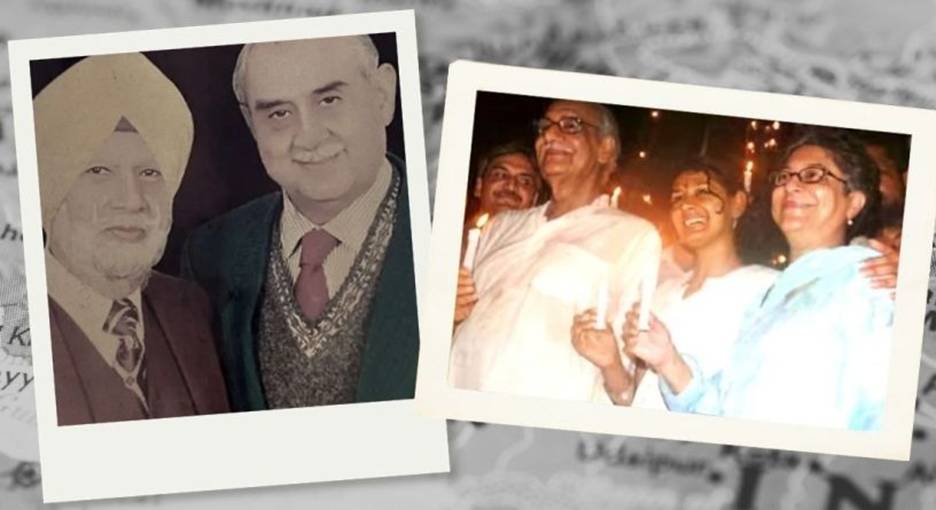
Sardar Harcharan Singh Brar and Syed Babar Ali - Aitcheson College archives. Celebrating Independence days together, 1990s: Journalist Kuldip Nayar, actor Nandita Das, human rights lawyer Asma Jahangir. Archive photo.
Syed Babar Ali and Harcharan Singh Brar: Sharing an Impeccable Friendship
By Beena Sarwar
Boston, MA
A few days before his 100th birthday on 30 June this year, Pakistan’s legendary industrialist, educationist and philanthropist Syed Babar Ali granted a rare video interview to freelance journalist Shumaila Khan at his residence in Lahore.
The interview was facilitated by a visitor to Pakistan from India — Dr Tarunjit Singh Butalia, who has been engaged in facilitating inter-faith dialogue and building people-to-people connections across the India-Pakistan border for decades.
With roots in Butala village near Gujranwala on the Pakistani side, he is also an honorary envoy for Aitcheson College, whose father, grandfather, and great-grandfather were alumni. Had it not been for the division, he too would have attended this institution, he told me over a call from Lahore, where he was cooking biryani for guests while staying on the College premises.
We had met at the Lahore Literature Festival in February this year during one of his frequent visits to the city. An American passport holder who teaches civil engineering at Ohio State University, he has no issues obtaining a visa to Pakistan despite his Indian origins. This is sadly not the case for most applicants.
A most moving interview
The interview he helped Shumaila with, for BBC Punjabi , was “the most moving” she has ever conducted, she told me over a call, because of how the centenarian remembered Sardar Harcharan Singh Brar, his childhood friend and a former Indian Punjab chief minister and later governor of Haryana and Odisha.
“Politics wasn’t the story,” she said. “Friendship was”.
She was struck by how their friendship “survived everything that should have divided them.”
In the years leading up to the independence and partition of India in 1947, Brar leaned toward the Congress Party while Ali supported the Muslim League.
“We debated politics, but we never allowed disagreements to affect our friendship,” Babar Ali told her.
Ali and Brar became friends from their first meeting in third grade at Aitchison College. They remained close while studying there, 1934 to 1943, and then at Government College (now University), Lahore.
“We lived like brothers,” said Babar Ali. “My mother observed purdah, but not from Harcharan.”
More than half a century later, on 10 June 2026, in a powerful symbolic gesture, Babar Ali got their alma mater to name a classroom after Brar. A plaque with his name is fixed outside classroom No108 of the Senior School; his photograph wearing the college blazer hangs inside.
This friendship “is a source of inspiration for young Pakistanis and Indians who will be the leaders of South Asia of tomorrow,” commented Dr Butalia .
Brar’s daughter Kanwaljit “Babli” Kaur, 73, traveled from Chandigarh, India, for the inauguration along with her friend Jyoti, and was present at Shumaila’s interview with her ‘chacha’ (uncle) as she calls Ali.
He had honored her father many times, she told Shumaila.
When Babar Ali built a library in Aitchison in 1989, he personally called Brar, who was then Chief Minister of Punjab, India, and asked him to inaugurate it — which Brar did.
Ready to die for Lahore
Brar had earlier attended the Aitchison College centenary celebrations in 1986, along with other alumni from India. “General Zia-ul-Haq invited them all to Islamabad,” recalled Babar Ali, recounting his friend’s words in response to a question from Gen Zia:
“If I could be certain that after death I would be born again in Lahore, I would be ready to die today.”
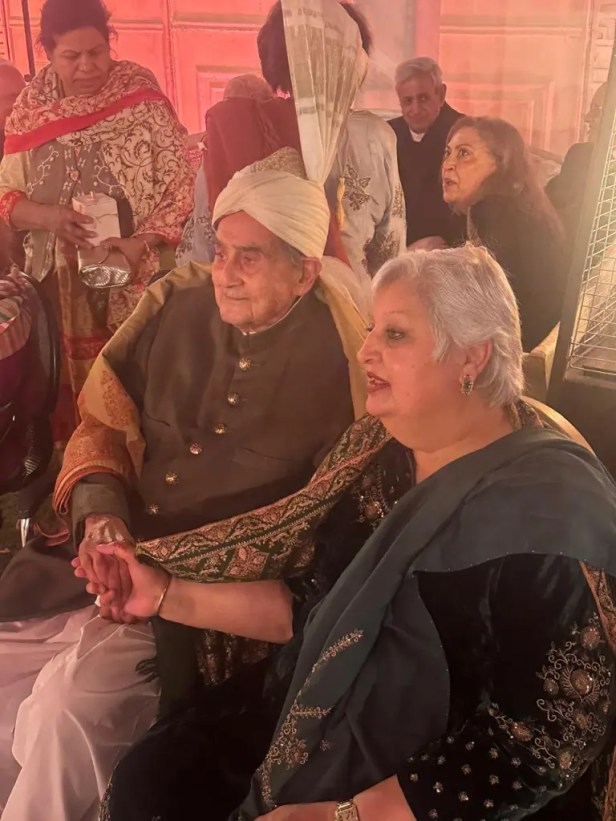
Syed Babar Ali and Babli Brar at Babar Ali’s grandson’s wedding, January 2025 Lahore
He also told Shumaila how his friend got married. “One day at Government College, Harcharan came to me with a newspaper and said, ‘There’s a girl who is a very good athlete, and I want to meet her. We discovered she belonged to a Jat family and was the niece of Sardar Partap Singh Kairon. Her father and uncle were both in prison at the time because of their support for the Congress movement.”
They found someone who could visit the jail and convey a marriage proposal on Harcharan’s behalf. The imprisoned men replied that they would make a decision once they were released. The wedding duly took place afterwards “and we celebrated it,” Ali told Shumaila.
The most emotional moment for Shumaila came when Babli Brar spoke about the relationship between the two families. “If my father was like a parent to us, then Babar Sahib was too.”
She said Babar Ali’s support helped her family to bear Brar’s passing in 2009. Saddened by her call informing him of his friend’s death, Ali accepted her invitation to attend the bhog ceremony that takes place after bereavement.
“When I arrived, there were around eighteen thousand people there,” he told Shumaila. “They asked me to speak first because I had been his closest friend.”
They had been so close that when Brar was going to the US for medical treatment, he asked Babar Ali to go with him, saying he didn’t need any other family members.
Dr Butalia documented their relationship in an article published in Dawn. Babli Brar also talked about it with the journalist Jugnu Mohsin, Babar Ali’s niece, in a video interview recorded during her last visit to Lahore.
On 3 November 2026, Aitchison will celebrate its 140th anniversary, expected to be attended by several alumni from India.
‘Milne Do’
“Even if we are separated by borders, our shared commitment to peace continues to unite us,” says Saeeda Diep of the Institute for Peace and Secular Studies, Lahore, who has been participating in this annual ceremony for years.
Babar Ali echoed these thoughts in his interview with Shumaila: “The tragedy is that our movement across the border has come to a halt. We speak the same language, share the same food, and have so much in common. But because of restrictions on contact, we are drifting apart.”
He concluded with a simple thought: “Just open the doors, and the very next day people will meet each other again.”
The story of his friendship with Harcharan Brar was not simply a story about two men, says Shumaila. “It was a story about a generation whose lives were reshaped by Partition but who refused to let borders define their relationships.”
The friendship between Syed Babar Ali and Harcharan Singh Brar, she said, “felt like a testament to that enduring spirit.”
The restrictions on contact may continue keeping people physically apart but the aspiration to meet remains alive, reflected in the slogan #MilneDo – let people meet.
(Beena Sarwar is the founder editor of Global Southasia (formerly Sapan News) syndicated features and has worked on people-to-people contact, peace and dialogue for over three decades. beena@sapannews.com
This is a Global South Asia (formerly Sapan News) syndicated feature - sapannews.com.