
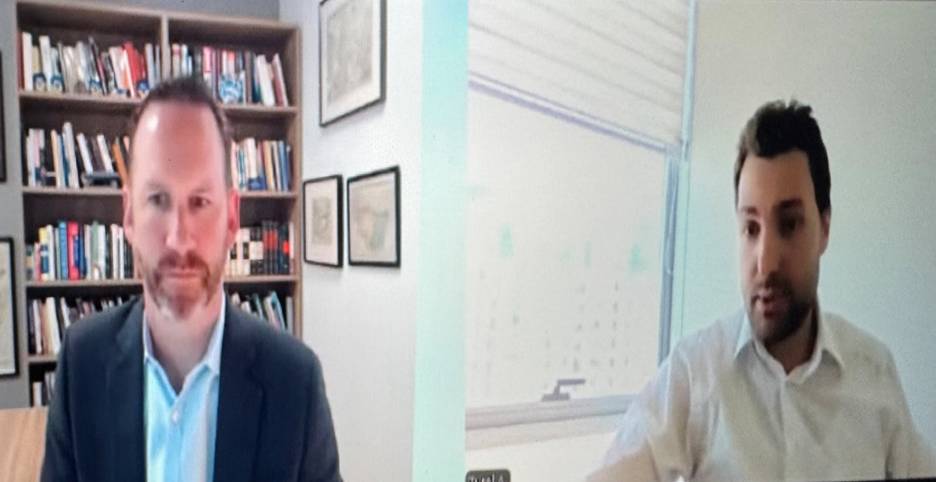
Luke Coffey (left) and Tural Akhundov
CRESCENT Research Center Spotlights Regional Impact of Iran War
By Elaine Pasquini

Washington, DC: When policymakers especially in Europe or the United States think about the consequences of the Iran war it’s in the context of its impact on the Gulf, the Middle East, or the Levant, Luke Coffey, senior fellow at the Hudson Institute, said in a September 8, 2026, interview with Tural Akhundov, public relations manager at CRESCENT Research Center, a Baku-based independent think tank. “Many don’t consider what the implications are for the South Caucasus, another region of the world that is important to Iran and also to Europe and the United States.”
One area for concern in the region is the Middle Corridor, officially the Trans-Caspian International Transport Route, which was launched in 2013 by Kazakhstan, Azerbaijan, Georgia and Türkiye as a trade corridor from Southeast Asia and China to Europe. It is the shortest route between the East and West, making it an important alternate transport route to bypass Iranian territory.
“Azerbaijan sits in a crucial crossroads in this sense,” Coffey explained. “It plays a very important role in the Middle Corridor.” When commercial airspace was closed down in Iran and the surrounding region due to the war, it was “a reminder of the geostrategic importance of the region and why the Middle Corridor matters and why it’s a real thing and why it has tremendous potential.”
A drone attack on Nakhchivan International airport in Azerbaijan in March which temporarily disrupted air travel in the area highlighted a vulnerability for countries in the region from threats coming from unmanned systems and underscored the need for other transit options.
The Caspian Sea can become a battleground and if it’s “not secure and stable then the Middle Corridor is not going to work,” Coffey stressed. “We saw an Israeli strike against the Iranian Naval fleet in the Caspian back in the spring and just recently we saw the Ukrainians for the first time hitting an Iranian vessel in the Caspian Sea, so this also serves as a reminder that it’s important to have good maritime security for the Middle Corridor to work.”
With respect to how the Iran conflict affects Russia’s war on Ukraine, Coffey pointed out that in Washington “all of the foreign policy bandwidth in the discourse is taken up by Iran. This doesn’t mean that there aren’t parts of the US government working on the Ukraine portfolio, there are, but at the highest levels of the US government the focus remains on Iran.”
This creates opportunities for Russia which will take advantage of a distracted US. “If President Trump is serious about finding a just and fair peace to this conflict, he is going to have to apply a little more focus and attention on it,” Coffey opined. “But so long as the situation in Iran stays as it is I think there is little prospect that 2026 will be a year of peace for Ukraine.”
Another area of concern in the region is TRIPP, the Trump Route for International Peace and Prosperity which, unfortunately, is progressing slowly. “The Azerbaijanis want to see this route physically being built and we haven’t seen that,” he explained. “We’ve had a lot of meetings, social media postings and everything else, but we haven’t actually seen construction on the ground.” This route is important for Azerbaijan because the country was promised a land connection to Nakhchivan during the November 2020 tripartite agreement that ended the second Nagorno-Karabakh war between Azerbaijan and Armenia.
TRIPP is important to Armenia because it could finally connect Armenia to regional transport infrastructure projects for the first time and it could boost the Armenian economy at a time when it needs it, he said. “So, it is in Armenia’s interest that it connects to the broader region.”
With respect to the United States and Europe, the passage is important because of precisely what is happening now with Iran and the Strait of Hormuz.
President Trump needs to get personally involved again in the South Caucasus, Coffey said. “Without US leadership on this, I fear we’ll see a very slow process that may not end in normalization and peace.”
(Elaine Pasquini is a freelance journalist. Her reports appear in the Washington Report on Middle East Affairs and Nuze.Ink.)
