
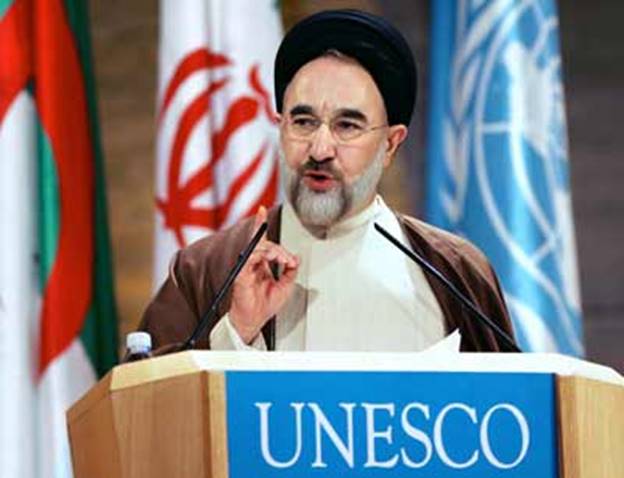
President Khatami believes that the dialogue among civilizations is both naturally occurring and a process that must be encouraged and facilitated, especially in the contemporary world where distances are growing smaller, we are grappling with transformative new technologies and scientific advances, and face new perils and dangers - Photo Reuters
President Khatami: The Champion of Dialogue among Civilizations
By Akbar Ahmed, Frankie Martin, Dr Amineh Hoti


In November 2001, two months after the devastating 9/11 attacks, Iranian President Mohammad Khatami visited New York for a meeting of the United Nations General Assembly. He had, three years earlier at the same venue, delivered a landmark speech calling for a “Dialogue among Civilizations” among the world’s nations and peoples. It was a reaction to both Samuel Huntington’s “Clash of Civilizations” thesis and the dominant “realist” framework of international relations theory which posits a Hobbesian struggle for supremacy based on “national interests” between states. The UN, inspired by Khatami’s speech, responded by declaring 2001 the “UN Year of Dialogue among Civilizations.” It was thus a cruel irony that 2001 was the year that the world plunged into renewed conflict, the reverberations of which are still playing out across the globe.
It was here in New York that I met Khatami during the General Assembly session. On the occasion of his visit, Khatami had invited around 20 leading Muslim scholars from America, including myself, for dinner. I was seated immediately on Khatami’s right. He spoke of his philosophy which leaned heavily on scholarship, understanding, and building bridges between different communities. He carried himself with dignity and spoke softly but with authority. I presented him my book Living Islam which I told him carried the same themes.
Some other dinner guests also made an impact, and I watched the interaction closely to see what it revealed about Khatami’s philosophy, particularly towards the United States and the West. The guests were complaining that they were being suppressed in the United States - “we are being victimized,” they said - and they pleaded to Khatami for help. Khatami could easily have taken the longstanding line of the Iranian leadership that the US was the “Great Satan” and encouraged the guests along these lines. But he said firmly, no. He told them this was not the forum and place for such a discussion and that he as a foreign leader would not comment or get involved in American politics. I’m sure your local authorities in the US will be able to deal with the problem, he added. This comparatively minor interaction suggested to me Khatami’s sincerity in seeking improved, normal, and correct relations between the US and Iran which had experienced an utter breakdown since the 1979 Islamic Revolution.
In his interview with a US newspaper during this session, his first since assuming the presidency in 1997, Khatami struck a similar tone. Addressing both America and the world, he said that the “dialogue” must continue—indeed it was now even more important. The perpetrators of 9/l1, he said, were a “cult of fanatics who had self-mutilated their ears and tongues and could only communicate with perceived opponents through carnage and devastation,” the polar opposite of dialogue. He expressed his wish, that “God willing, as God has wanted for us, all of us, Christians [,] Jews, Muslims, everyone, can interpret religion in a free manner based on wisdom and foresight to protect our religion as well as to provide peace for our region.” And he asserted, “we must strongly prevent a clash among civilizations and religions and the spread of hatred.” Khatami even suggested that Iran might be willing to recognize the State of Israel, providing the Palestinians reached a peace agreement with Israel.
A few years later, my distinguished colleague Brian Forst and I compiled an edited volume, After Terror: Promoting Dialogue Among Civilizations. We invited leading thinkers to utilize and develop Khatami’s framework to reflect on how they believed the world

Among those who contributed were Kofi Annan, Archbishop Desmond Tutu, Chief Rabbi Jonnathan Sacks, Lord Carey and Prince Hassan bin Talal of Jordan. We also reached out to Khatami to contribute a piece. To my delight, he agreed and sent a powerful essay
could move towards this paradigm. Among those who contributed were Kofi Annan, Archbishop Desmond Tutu, Chief Rabbi Jonnathan Sacks, Lord Carey and Prince Hassan bin Talal of Jordan. We also reached out to Khatami to contribute a piece. To my delight, he agreed and sent a powerful essay. In it, Khatami discussed ways to bring “the hearts of people closer together” across the world, and the importance of tolerance, listening, and scholarship and knowledge in the task of dialogue. He also stated that despite all the challenges to the dialogue paradigm, he was cheered by the fact that so many people around the world had adopted and promoted it: “The fact that this proposal was welcomed by the international community, and specifically lauded at the United Nations General Assembly by the collective of its member states, as well as by intellectuals and world public opinion, is itself important and valuable.” Jimmy Carter provided us a blurb for the cover of the book: “I strongly recommend it.”
In 2006, a year after Khatami’s essay was published in After Terror, we made another connection with him. We were in Amman, Jordan conducting fieldwork for our study Journey into Islam, the first in a quartet of studies we produced on the relationship between Islam and the West published by Brookings Institution Press. I had just spoken at the Royal Institute for Interfaith Studies, an organization established under the patronage of Prince Hassan of Jordan, the uncle of King Abdullah. After the event, the Pakistani ambassador to Jordan hosted a dinner for us at an elegant upscale restaurant. Joining us were diplomats, cabinet officials, and others from Pakistan, Jordan, and other countries. At the table next to us sat Ayad Allawi, Iraq’s former prime minister. The atmosphere was tense as sectarian violence had just exploded in Iraq and the Danish cartoons of the Prophet of Islam were provoking mass protests.
As Frankie Martin recounts, “I struck up a conversation with a gentleman sitting next to me, who said he was from Iran. I voiced my respect and appreciation for President Khatami, who had recently left office, for launching the Dialogue among Civilizations initiative. In particular, the major speech that Khatami had given on the subject at the United Nations. I told him that I was finding that our fieldwork validated the president’s speech. Muslims I had met were upset at the conflicts and political problems plaguing their societies. But what seemed to be concerning them the most was the perception that Americans and Westerners hated them for simply being Muslim and were attacking their religion, a view reinforced by the media. The idea of a Dialogue among Civilizations, I said, was needed now more than ever, particularly because many Americans and Westerners have similar ideas about Muslims. A huge smile crossed the man’s face. ‘It is so wonderful to hear you say that. I am on President Khatami’s personal staff. I helped write that speech. And I agree.’”
References to “I” refer to me, Akbar Ahmed, and “we” to all three authors.
Elaine Sciolino, “Iran Chief Rejects Bin Laden Message,” The New York Times, November 10, 2001.
President Seyed Mohammed Khatami, “Dialogue among Civilizations and Cultures.” In Akbar Ahmed and Brian Forst, eds., After Terror: Promoting Dialogue among Civilizations (Cambridge: Polity, 2005), pp. 73, 74, 77.
Khatami is a crucially important international statesman and scholar. He is significant on multiple levels. For Iran, he is more than a president—he is the spiritual, ideological, and symbolic architect and leader of the reform movement, which has been striving for decades for a more open and tolerant Iran which is accountable to its people, accepting of minorities, and seeking good relations with the world, including the West. Then, for the world, Khatami offers ways of interpreting national identity for the world’s nations which incorporate the different cultural and religious influences which shape those nations. Khatami also offers a model for reconciling reason, philosophy, scientific advancement, and modernity with religion, revelation, and tradition, and for encountering one another in mutually beneficial interactions which allow us all to explore and get closer to truth. Khatami is a big picture thinker who offered his bold vision of dialogue as being the potential cornerstone of the post-Cold War world order. Despite the challenges of the global developments post-2001, it remains a vital paradigm for creating a better world. At the UN, Khatami’s vision has been institutionalized in its Alliance of Civilizations initiative.
For us, the authors, Khatami is also a great “Mingler,” or a person who embraces the “Other” regardless of religion, race, ethnicity, tribe, or nation. In this article, we will discuss those aspects of Khatami’s thought relevant to the “Other” which we may learn from. He has much wise counsel for a world in the throes of violence pitting people of different religions, races, ethnicities, tribes, and nations against each other—and in no region more so than in his own, Iran and the Middle East.
During this period in which the entire Middle East threatens to spiral even further into the madness of war, even including discussions of the possibility of nuclear strikes, we must pull back from the brink. Khatami presents a way for us to do so. His example is also crucial because Iran continues to be stereotyped in the United States and globally as a nation of fanatics and terrorists—Khatami and his reform movement are simply erased from existence. His position is very important for us to consider amid this seemingly unending cycle of violence.
For a statesman and thinker of his stature and significance, Khatami is not nearly as well-known internationally as he should be. In this piece, after introducing Khatami in his own Iranian context, we will move on to discuss his relevance for our world, chiefly his approach to different cultures and religions and human coexistence. Let us meet Khatami so we may benefit from his thinking on moving the Middle East and the world away from clash and conflict and towards coexistence and meeting one another with curiosity, empathy, love, and respect.
The life of Khatami
Mohammad Khatami was born in 1943, in Ardakan, in the Yazd province in central Iran. His father was one of Iran’s most beloved religious leaders, Grand Ayatollah Ruhollah Khatami, and his mother the daughter of a wealthy landowner. Khatami’s father was highly respected for his piety and was open-minded, encouraging his children to read novels, poetry, and newspapers, and listen to radio news broadcasts. Early in life, we can already see Khatami’s longstanding educational interests developing which spanned religious studies and philosophy. In 1961, at the age of 19, he entered the Theology School at Qom, the scholarly center of Shia Islam, where he became a disciple of Ayatollah Khomeini and a close friend of Khomeini’s son. Khatami went on in 1965 to study for a bachelor’s degree in philosophy at the University of Isfahan, a secular university, which was a relatively rare practice among Shia clergy. While some clerics avoided military service, Khatami served his mandatory two-year service, attaining the rank of junior lieutenant in the army of the Shah of Iran.
Khatami returned to Qom where he studied ijtihad or religious interpretation, then received a masters’ degree in education from the University of Tehran before again studying in Qom and focusing on jurisprudence, Islamic law, and philosophy. In 1975 he attained the clerical designation of hojjatoleslam, and became politically active in the Islamic movement before and after the Islamic Revolution. He wore a black turban, indicating descent from the Prophet of Islam. In 1978, he moved to Hamburg, Germany to head the Hamburg Islamic Center, “one of the oldest and the most influential Iranian Shi’i centers in Europe,” and remained until 1980, when he returned to Iran. He was elected to the Majles or Iranian parliament representing his home area of Ardakan, and he briefly headed the influential Kayhan newspaper, appointed by Ayatollah Khomeini, before becoming Minister of Culture and Islamic Guidance in 1982. During the Iran-Iraq War, Khatami served as head of the Joint Command of the Armed Forces and chairman of War Propaganda Headquarters.
By 1987, eight years into the Islamic revolutionary regime in Iran, Khatami was already moving towards promoting reform of the system. While serving as Minister of Culture and Islamic Guidance in the years following Khomeini’s death in 1989, for example, Khatami increased the number of licenses given to periodicals from just over 100 to well over 300. As such, he provoked the opposition of conservative clerics, a pattern and dynamic which would persist for the entirety of Khatami’s career. In 1992, under increasing pressure from conservative forces, Khatami chose to resign his position as Minister of Culture and Islamic Guidance. He went on to serve as head of Iran’s National Library and advisor to Iranian President Akbar Hashemi Rafsanjani, and he also lectured in political theory and philosophy at Tarbiat Modares University.
There was an increasing crackdown on those promoting reform during this time, and by 1994 hundreds of intellectuals and dissidents had been imprisoned, and some executed. For Khatami this period was one of intellectual refuge. He used the opportunity of being out of high government office to devote himself to religious and philosophical studies, particularly focusing on the intellectual traditions of Islam and the West. He wrote several books on these themes including From the World of the City to World-City: A Study of Political Thought in the West; Fear of the Wave, and Religion and Thought in the Snare of Autocracy: A Study in the Political Thought of Muslims during the Ascent and Descent of Islamic Civilization.”
By the time Khatami reemerged in 1997 to run for Iran’s presidency, he had a fully formed political platform backed by big ideas. The future of Iran, the Islamic world, and the world generally, he argued, should be shaped by dialogue between those representing different cultural and religious identities. The core of this quest is the concept of liberty, especially liberty in thought, and Khatami affirmed, “The history of humankind is the history of liberty.” Khatami believed that people should have the freedom to express themselves and interact with each other, in the context of society’s agreed upon limitations. With freedom, humanity can move closer to its natural state, when people are “liberated from imposed constraints of exploitation and social enslavement as well as from unrefined animal instincts as violence and savagery.” In the context of contemporary Iranian society, this meant a conceptual shift away from the power of the ruling clerical establishment and towards the
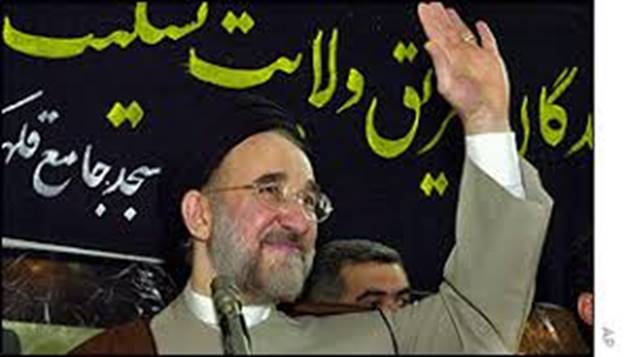
Khatami was adamant that Islam and democracy were compatible. Discussing this subject, Khatami affirmed that it is “possible for a government whilst attributed (motnaseb) to God” to “also be based on the vote of the people. I am convinced that we have started a new experience, in other words a holy government (hokumat-e-elahi) which is the people’s and is named Islamic Republic.” - Photo BBC
people. It was a belief that democracy must be established in the context of Iran’s Islamic Republic, and “the fate of religion in Iran depends on the ability to render it compatible with freedom.” What applied to Iranians also applied to humanity, Khatami believed, and he contended, “if humanity is looking for happiness, it should combine religious spirituality with the virtues of liberty.”
Khatami was adamant that Islam and democracy were compatible. Discussing this subject, Khatami affirmed that it is “possible for a government whilst attributed (motnaseb) to God” to “also be based on the vote of the people. I am convinced that we have started a new experience, in other words a holy government (hokumat-e-elahi) which is the people’s and is named Islamic Republic.”
Khatami’s vision: The ideal of Medina
For Khatami, the Islamic Revolution was an ongoing process, not a settled matter. Simply instituting religious dogma as official state ideology, Khatami argued, is not a true Islamic Republic. He identified a tendency among some to retreat to rigid dogmatic positions and justify these based on living in an “Islamic Republic,” but such thinking was detrimental, Khatami insisted. He invoked Ayatollah Khomeini’s example, establishing Khatami’s core argument that his vision for an Islamic democracy was compatible with Khomeini’s thinking. Khatami asserted, “The effect of dogma on our society which has a religious identity is vast. And its negative effect is greater than secularism, especially because dogmatic believers usually project the aura of religious legitimacy…Imam Khomeini, especially in the last two years of his life, was deeply concerned with the danger that dogma and backward vision posed to the revolution’s path and the progress and welfare of Islamic society.”
The question of how to interpret religion in the Islamic Republic of Iran also had global resonance, Khatami noted, given the lasting impact of Iran’s revolution on the Islamic world: “The Islamic revolution has spread its momentum across the Muslim world and beyond. It has given new hope to Muslims and downtrodden peoples who seek freedom and justice, hence affecting the world’s intellectual and political climate.” While some assume, Khatami stated, “that since our revolution has succeeded and an Islamic Republic established, the victory of real Islam will be assured automatically,” but this is incorrect: “No, we face serious difficulties and dangers…the devotees of real Islam must equip themselves with rationality, thought, and logic more than ever before.”
Like one of his central intellectual influences, Al Farabi, who lived over a thousand years ago and reconciled Greek philosophy and Islam, Khatami’s ideal society which he attempts to orient Iran towards is Medina at the time of the Prophet of Islam. Muslims should reflect on the principles of Medina, which represent the Muslim “moral geography” and “moral abode” according to Khatami, and try to implement them in the context of today’s world. These include rights for women and minorities, rule of law, tolerance for multiple views, and avoiding force and coercion. The goal is to achieve what Khatami calls the “Good Society” encompassing such characteristics.
The ideal of Medina is especially important for Iranian and Muslim society, Khatami believed, because in the centuries after Medina, ideals of Islamic rulership, influenced by pre-Islamic monarchical and imperial systems, moved towards authoritarianism and tyranny. The Prophet’s Medina, in contrast, Khatami argued, was characterized by “collective decision making, reconciliation, and the supremacy of the public interest,” a model that was sustained “to some extent by the Caliphs who succeeded him, especially by Imam Ali,” but not very much longer.
Khatami laments that the advancements of Al Farabi, who Khatami asserted dedicated “deep thought to philosophy, politics, and civic discourse,” were not continued by later Islamic philosophers. This led to a tendency in Muslim societies, Khatami believed, for scholars to attempt to justify autocracy. The best they could do was to counsel the Sultan to treat people kindly and avoid God’s wrath or impart particular techniques to help rulers maintain power—but this still left society with unaccountable monarchs. Another response was Sufism, which Khatami appreciates, but notes that it was not directly concerned with the issue of autocracy and how to overcome it in the manner considered by Al Farabi.
The Islamic Republic of Iran should thus continue to develop in line with Islamic thinking consistent with the guidance of the Prophet of Islam, Medina, and the “golden age” of Islamic civilization exemplified by Al Farabi, but in a modern context, striking its own balance between competing ideas and between Islamic, Persian, and Western influences, all of which for Khatami form important parts of the Iranian identity. It is also important for Iranians and Muslims, as indeed it is for all humans, Khatami taught, to balance reason with religion, and science and technology with humanity. While prior to Khatami’s presidency these elements had often been pitted against each other, Khatami believed not only that they could be reconciled but that they necessarily should. Indeed, Khatami was the first leading cleric in post-Revolution Iran “to acknowledge openly Iran’s pre-Islamic heritage and its role in present-day identity.”
This idea of a balance or reconciliation of different streams of identity and intellectual influences set Khatami up for his approach to foreign policy and international relations—to enact a similar dialogue between civilizations on the world stage as an offering to humanity. Khatami pointed out that in history, “Islam has embraced opposing views with open arms. Seminal Muslim thinkers have actively sought the encounter of
Elaine Sciolino, “Mullah Who Charmed Iranians Cannot Change Status Quo,” The New York Times, February 1, 1998.
Daniel Brumberg, Reinventing Khomeini: The Struggle for Reform in Iran (Chicago: The University of Chicago Press, 2001), p. 196.
Farzin Vahdat, Islamic Ethos and the Specter of Modernity (London: Anthem Press, 2015), p. 180.
Mohammad Khatami, Islam, Dialogue and Civil Society (Canberra: Centre for Arab and Islamic Studies (The Middle East & Central Asia), The Australian National University, 2000), p. 114.
Vahdat, Islamic Ethos and the Specter of Modernity, p. 180.
Azadeh Momeni, The Presidential Difference and Iran’s Foreign Policy under Khatami from 1997 to 2005 (Lanham, MD: Lexington Books, 2024), p. 50.
Brumberg, Reinventing Khomeini, p. 197; Vahdat, Islamic Ethos and the Specter of Modernity, p. 180.
Zhand Shakibi, Khatami and Gorbachev: Politics of Change in the Islamic Republic of Iran and the USSR (London: Tauris Academic Studies, 2010), p. 148.
Vahdat, Islamic Ethos and the Specter of Modernity, p. 180.
Brumberg, Reinventing Khomeini, p. 186.
Vahdat, Islamic Ethos and the Specter of Modernity, p. 182.
Mohammad Khatami, “Statement by H.E. Mohammad Khatami, President of the Islamic Republic of Iran, before the 53rd Session of the United Nations General Assembly,” Pars Times, September 21, 1998: https://www.parstimes.com/history/khatami_speech_un.html
Mohammad Khatami, “Statement by H.E. Mohammad Khatami, President of the Islamic Republic of Iran, before the 53rd Session of the United Nations General Assembly,” Pars Times, September 21, 1998: https://www.parstimes.com/history/khatami_speech_un.html
Shakibi, Khatami and Gorbachev, p. 304.
Shakibi, Khatami and Gorbachev, p. 335.
Golnar Mehran, “Khatami, Political Reform and Education in Iran,” Comparative Education, vol. 39, no. 3, 2003, p. 314.
“Transcript of interview with Iranian President Mohammad Khatami,” CNN, January 7, 1998.
Shakibi, Khatami and Gorbachev, p. 304.
Mohammad Khatami, Islam, Liberty, and Development (Binghamton, NY: Institute of Global Cultural Studies, Binghamton University, 1998), pp. 75-76.
Khatami, Islam, Liberty, and Development, p. 97.
Khatami, Islam, Liberty, and Development, p. 118.
Khatami, Islam, Dialogue and Civil Society, p. 17.
Khatami, Islam, Dialogue and Civil Society, pp. 17-18.
Shaul Bakhash, “Iran’s Unlikely President,” The New York Review of Books, November 5, 1998.
Vahdat, Islamic Ethos and the Specter of Modernity, p. 184.
Khatami, Islam, Liberty, and Development, p. 7.
Khatami, Islam, Liberty, and Development, p. 8.
Vahdat, Islamic Ethos and the Specter of Modernity, p. 184.
Vahdat, Islamic Ethos and the Specter of Modernity, p. 184.
Khatami, Islam, Liberty, and Development, p. 9.
Shakibi, Khatami and Gorbachev, p. 168.
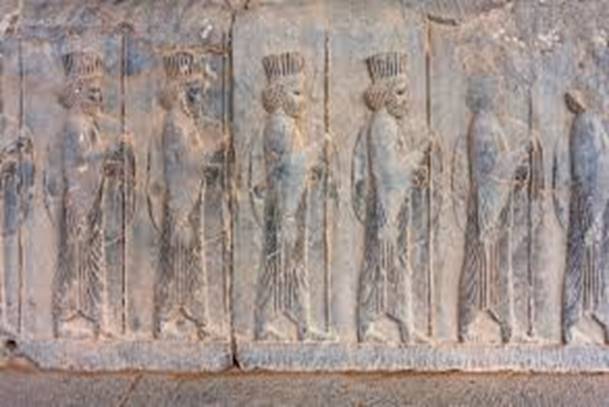
It is also important for Iranians and Muslims, as indeed it is for all humans, Khatami taught, to balance reason with religion, and science and technology with humanity. While prior to Khatami’s presidency these elements had often been pitted against each other, Khatami believed not only that they could be reconciled but that they necessarily should. Indeed, Khatami was the first leading cleric in post-Revolution Iran “to acknowledge openly Iran’s pre-Islamic heritage and its role in present-day identity.” – Image Stimson Center
other views. This openness has imbued Islamic civilization with much intellectual weight.”
Khatami’s electoral triumph
Going into the 1997 presidential election, few observers gave Khatami much of a chance. Many among the religious establishment and major government institutions were against him, and the Supreme Leader of Iran, Ayatollah Ali Khamenei, implicitly endorsed Khatami’s rival Ali-Akbar Nateq-Nuri, a cleric and the speaker of parliament, insisting that “if anyone, out of those people who enter into the arena of the presidency shows the slightest sign of being soft toward the United States...toward the cultural and political attacks of foreigners…the nation will definitely not vote for such a person.” It was reported that “Iran’s political machine had never been so blatant in its backing of a single candidate who espoused the same staunch conservative views.” Nateq-Nuri accused Khatami of siding with opponents of Iran, associating with people intoxicated by the West, and sympathizing with the “rap generation.”
In the end, however, Khatami pulled off an astounding landslide, indicating Iran’s appetite for change. Out of 30 million votes cast, Khatami won 70 percent. 80 percent of voters turned out, surpassing all records including Khomeini’s 1979 Islamic constitutional referendum. Khatami’s core supporters included students, the youth, intellectuals, pro-democracy activists, human rights activists, women, ethnic minorities, the middle class, and the poor. Perhaps most notably, Khatami also attracted considerable support from Iran’s religious establishment. In Qom, the center of Shia theological study, 70 percent of voters chose Khatami. Khatami’s tally among Iran’s ultraconservative Revolutionary Guard military forces was essentially the same, at 69 percent. Khatami did well in nearly all provincial districts, “even in small towns and villages where citizens traditionally follow the advice of local religious leaders.”
Such support reflected the esteem with which figures at the highest echelons of the establishment held Khatami. Even Ayatollah Khamenei, who was commonly held to have differing philosophical views from Khatami, had close connections with him and there was more nuance in the relationship than might have appeared on the surface. Khamenei had been a devoted disciple of Khatami’s father, and the Khatami and Khamenei families vacationed together.
Khatami’s victory was described as the start of a new era in the nation’s history and a second revolution. Reporting on Khatami, the New York Times correspondent Elaine Sciolino observed, “he would get on a bus and kiss babies and shake hands…he had such an extraordinary personality…He charmed the people of Iran. He charmed them with his personality, with his good looks, and with his promises.”
Khatami’s platform during the campaign included the assertation that the nation’s parliament “was the highest seat of national sovereignty” and that the constitution was
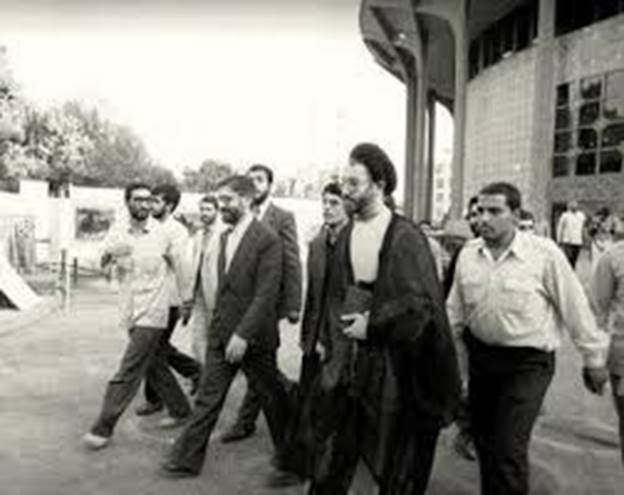
Khatami’s victory was described as the start of a new era in the nation’s history and a second revolution. Reporting on Khatami, the New York Times correspondent Elaine Sciolino observed, “he would get on a bus and kiss babies and shake hands…he had such an extraordinary personality…He charmed the people of Iran. He charmed them with his personality, with his good looks, and with his promises.” - IranWire
“the basis of the…political structure.” This set up a potential clash with the Supreme Leader, the clerical establishment, and those who believed that the ruling clerics should have paramount authority.
And yet, as previously noted, Khatami argued that his ideas were firmly in keeping with the vision of Ayatollah Khomeini—Khatami quoted such Khomeini sayings as “Each and every member of [the] nation had the right to directly and publicly impeach and criticize. If he fails to do so, he has acted against his Islamic responsibility” and “People who are in the rank of opposition are free to express their disagreements and the high clergy of towns, and villages, and the nation itself, have the responsibility to protect such freedom.”
Khatami and his followers also interpreted Khomeini’s statements on the office of Supreme Leader (vali-e-faqih) to indicate that “the vali-e-faqih’s legitimacy is temporal, and that he should be subject to democratic checks and balances,” while conservatives, also basing their arguments in Khomeini’s thought, believed the Supreme Leader to be the representative of the Twelfth Shia Imam, who will return in the End Times, and thus is “exempt from temporal accountability.” Khatami stated that he believed the clergy should remain “aloof from the unwanted negative consequences of being too close to power and government, which could prevent them from their essential mission of providing spiritual and religious guidance to society.” The election results indicated that a great number of Iranians believed in Khatami’s interpretation of the Islamic Revolution and Khomeini’s teachings, and his vision for the future development and course of the Islamic Republic. Khatami’s reform movement was known as Dovom-e Khordad, which took its name from the Persian calendar date on which Khatami triumphed in the election.
“Our Napoleon”: Khatami in office
Khatami assumed the presidency as the most popular man in the nation, “greeted as a national hero, and treated like a rock star.” An Iranian woman quoted in the media captured how many of Khatami’s supporters saw him: “our Napoleon with a book, instead of a sword, in his hand.” Wherever he went, he was greeted with exuberant crowds. He made a point of visiting people in ordinary locations, turning up unannounced to places such as schools, shops, food ration lines, and hospitals.
In his inaugural address in August 1997, Khatami called for “the free exchange of ideas” and stated, “The government must emphasize that in our world, dialogue among civilizations is an absolute imperative. We shall avoid any course of action that may foster tension. We shall have relations with any state which respects our independence…The Islamic government is the servant of the people and not their master, and it is accountable to the nation under all circumstances.” Khatami repeatedly spoke of the importance of free inquiry, for example in education, asking “Why should we not allow our young to raise their serious questions about God, the Prophet, religion, the Constitution, the Islamic Republic, the country’s domestic and foreign policy, economy, veiling, and me—a clergyman who is governing them?” He further insisted, “There are no forbidden zones…one can question whether or not atom exists; or whether there is a God or not; or whether God possesses certain attributes or He does not.” Intrigued international observers wondered what direction Iran would now take given that it had a president who “has written approvingly of Locke and Rousseau.”
Shakibi, Khatami and Gorbachev, p. 168.
Khatami, Islam, Liberty, and Development, p. 111.
Brumberg, Reinventing Khomeini, p. 228.
Ghoncheh Tazmini, Khatami’s Iran: The Islamic Republic and the Turbulent Path to Reform (London: Tauris Academic Studies, 2009), p. 51.
Tazmini, Khatami’s Iran, p. 53.
Brumberg, Reinventing Khomeini, p. 228.
Jahangir Amuzegar, “Khatami’s Legacy: Dashed Hopes,” Middle East Journal, vol. 60, no. 1, 2006, p. 59.
Amuzegar, “Khatami’s Legacy,” p. 60; Tazmini, Khatami’s Iran, p. 54.
Tazmini, Khatami’s Iran, p. 55.
Michael Eisenstadt, “The Military Dimension.” In Patrick Clawson, Michael Eisenstadt, Eliyahu Kanovsky, and David Menashri, Iran Under Khatami: A Political, Economic, and Military Assessment (Washington, DC: The Washington Institute for Near East Policy, 1998), p. 73.
Shaul Bakhash, “Iran’s Unlikely President,” The New York Review of Books, November 5, 1998.
Tazmini, Khatami’s Iran, p. 56.
Elaine Sciolino, “Mullah Who Charmed Iranians Cannot Change Status Quo,” The New York Times, February 1, 1998.
Amuzegar, “Khatami’s Legacy,” p. 59.
Tazmini, Khatami’s Iran, p. 52.
Amuzegar, “Khatami’s Legacy,” p. 59.
Tazmini, Khatami’s Iran, p. 52.
Brumberg, Reinventing Khomeini, p. 1.
Tazmini, Khatami’s Iran, p. 135.
Christopher de Bellaigue, “The Struggle for Iran,” The New York Review of Books, December 16, 1999.
Brumberg, Reinventing Khomeini, p. 234.
Elaine Sciolino, “Mullah Who Charmed Iranians Cannot Change Status Quo,” The New York Times, February 1, 1998.
Amuzegar, “Khatami’s Legacy,” p. 57.
Amuzegar, “Khatami’s Legacy,” p. 57.
Christopher de Bellaigue, “The Struggle for Iran,” The New York Review of Books, December 16, 1999.
Tazmini, Khatami’s Iran, p. 137.
Khatami, Islam, Liberty, and Development, pp. 146, 150.
Mehran, “Khatami, Political Reform and Education in Iran,” p. 323.
Vahdat, Islamic Ethos and the Specter of Modernity, p. 187.
Shaul Bakhash, “Iran’s Unlikely President,” The New York Review of Books, November 5, 1998.
The differences in the views of identity among the nation’s leadership and the question of how Iran should engage with the world, however, were on full display at the Organization of Islamic Cooperation conference held in Tehran in December 1997. Khatami, sticking to his theme of dialogue, “spoke of a ‘Western civilization…whose accomplishments are not few’ and of an ‘interdependent world…where the security of different
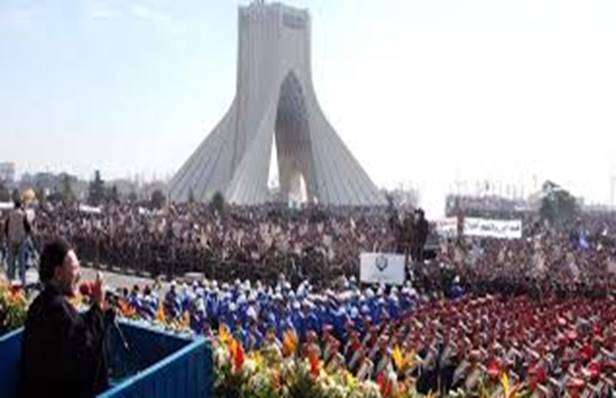
Intrigued international observers wondered what direction Iran would now take given that it had a president who “has written approvingly of Locke and Rousseau.” – Photo NBC News
regions is indivisible…[and requires] striving toward mutual trust.” In contrast, Ayatollah Khamenei, who also addressed the assembly, asserted, “[t]he West, with its comprehensive invasion, has…targeted our Islamic faith…[and has] exported the…disregard for religion and ethics [that will]…engulf the present Western civilization and wipe it out.” The CNN journalist Christiane Amanpour observed, “If a person from outer space had been watching the opening ceremonies of the OIC, he would have heard two completely different speeches”—with Khamenei “talking about conflict, enemies and harping on the past” and Khatami “talking about dialogue, understanding and moving forward,” and she asked, “Which is the real Iran[?]”
Khatami wasted no time in beginning to implement his reforms, most notably in his inclusive political rhetoric and opening up the society to more debate. He stated, “We need organized political parties, social associations, and an independent free press to provide channels to convey to the state the people’s needs. The government must eliminate obstacles to the expansion of these channels…We have no other path except moderation and dialogue…and to people intending to use violence and harshness, even if they have good intentions, we say that violence and harshness will not work. The more independent and free the press, the greater their representation of public opinion.”
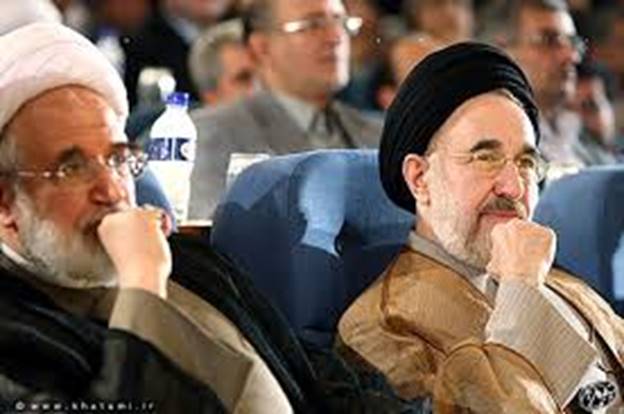
The CNN journalist Christiane Amanpour observed, “If a person from outer space had been watching the opening ceremonies of the OIC, he would have heard two completely different speeches”—with Khamenei “talking about conflict, enemies and harping on the past” and Khatami “talking about dialogue, understanding and moving forward,” and she asked, “Which is the real Iran[?]” – Photo PBS
Khatami followed such words with action, facilitating an explosion of newspapers and periodicals and clearing more political parties. A little over two years into his first term, 64 new political parties and groups were given permission to operate. The “morals police” were also relaxed, and women appeared in public “with lipstick, nail polish, and more of their hair showing; and young men and women mix more freely.” There was a notable change in the behavior of government officials, and it was reported that “politicians, civil servants and bureaucrats became more mild-mannered, especially in dealing with women and young people. Haggardness and brutishness were replaced with refinement and respect.”
And yet, as a political phenomenon and head of the reform movement, opinions of Khatami were sharply polarized—there were, one scholar reported, “no lukewarm opinions; people are almost invariably for or against him.” Despite Khatami’s massive mandate, and possibly because of it, opposition from the conservative establishment steadily increased during his presidency. Conservative forces took every opportunity to undermine Khatami and his allies across the media, government, and the universities. While Khatami freely issued press permits, for example, courts which were beyond Khatami’s influence blocked them, closing publications and arresting editors. The judiciary along with the security forces “made every effort to muzzle ‘liberal’ intellectuals and clerics.” Khatami complained of the effects of such forces, claiming on numerous occasions that his administration was plagued by “a crisis every nine days.”
Yahya Rahim Safavi, the commander of the Revolutionary Guard, spoke in scathing terms about Khatami’s supporters, describing them as “diseased people,” and said that liberals had taken control of the nation’s universities. He warned that the Revolutionary Guard “would have to ‘cut the throats and tongues’ of those who were undermining the regime” and vowed to “root out counter-revolutionaries wherever they are.” “Our language is that of the sword and seekers of martyrdom,” he added. A high ranking cleric, Ayatollah Mesbah Yazdi, also spoke of violence, asserting, “They (the enemies of Islam) have presented principles such as tolerance and compromise as absolute values whilst violence is regarded as a non-value…the taboo that every act of violence is bad and every act of tolerance is good must be broken.” Another senior cleric, Ayatollah Mohammad Yazdi, the head of Iran’s judiciary, warned, “Some of the mass media imagine that they can do whatever they want…Our youth will not tolerate aggression against Islam.” “(T)hose who go on about reformism,” Ayatollah Mohammad Yazdi said, “are in fact trying to revive the traditions of apostates of 2,500 years ago in Iran’s Islamic society…Our brothers in the basiji and the police…must increase their moral, social, and cultural enforcement and carry out Islamic punishments so that the middle class gets fed up and comes to the conclusion that the reformists are incompetent.”
A further senior cleric, Ayatollah Abu Al-Ghasem Hozali, speaking after a Khatami speech on political change, stated, “In this meeting Islam was slapped in the face…Chicken pox has infected the Revolution,” and he called for Khatami to admit his error. Ayatollah Khamenei also alerted the reformers: “The enemy is striking Islam from home…I warn against the abuse of freedom by certain quarters of the press. Prevention of their devious acts is not difficult.”
During this period, hardline vigilante groups with ties to security agencies became “increasingly active, bold, and violent, while seeming to operate with impunity.” Khatami’s closest allies were targeted. The mayor of Tehran, Gholam-Hossein Karbaschi, one of Khatami’s most important political strategists and secretary general of the faction providing most of Khatami’s support in parliament, was arrested on corruption charges. The cleric, newspaper publisher, and Iranian Minister of the Interior Abdollah Nouri and Ata’ollah Mohajerani, Iran’s Minister of Culture and Islamic Guidance, were both
Shaul Bakhash, “Iran’s Unlikely President,” The New York Review of Books, November 5, 1998.
Brumberg, Reinventing Khomeini, p. 4.
Brumberg, Reinventing Khomeini, p. 4.
Brumberg, Reinventing Khomeini, pp. 4-5.
Shakibi, Khatami and Gorbachev, p. 233.
Brumberg, Reinventing Khomeini, pp. 4-5.
Shakibi, Khatami and Gorbachev, p. 235.
Tazmini, Khatami’s Iran, p. 74.
Shaul Bakhash, “Iran’s Unlikely President,” The New York Review of Books, November 5, 1998.
Tazmini, Khatami’s Iran, p. 137.
Tazmini, Khatami’s Iran, p. 151.
Brumberg, Reinventing Khomeini, p. 232.
Shakibi, Khatami and Gorbachev, p. 235.
Brumberg, Reinventing Khomeini, p. 2.
Amuzegar, “Khatami’s Legacy,” p. 60.
David Menashri, “Whither Iranian Politics?: The Khatami Factor.” In Patrick Clawson, Michael Eisenstadt, Eliyahu Kanovsky, and David Menashri, Iran Under Khatami: A Political, Economic, and Military Assessment (Washington, DC: The Washington Institute for Near East Policy, 1998), p. 34.
Shaul Bakhash, “Iran’s Unlikely President,” The New York Review of Books, November 5, 1998.
Eisenstadt, “The Military Dimension,” p. 73.
Shakibi, Khatami and Gorbachev, p. 236.
Shakibi, Khatami and Gorbachev, p. 323.
Shakibi, Khatami and Gorbachev, p. 236.
Shakibi, Khatami and Gorbachev, pp. 326-327.
Shakibi, Khatami and Gorbachev, p. 326.
Shakibi, Khatami and Gorbachev, p. 236.
Michael Stein and Fred S. Lafer, “Preface.” In Michael Rubin, Into the Shadows: Radical Vigilantes in Khatami’s Iran, Policy Papers no. 56. (Washington, DC: The Washington Institute for Near East Policy, 2001), p. ix.
Shaul Bakhash, “Iran’s Unlikely President,” The New York Review of Books, November 5, 1998. beaten up by a group allegedly belonging to Ansar-i Hizbullah, a government-linked paramilitary organization. Nouri was sentenced to five years in prison for having “defamed the system,” while the Islamic scholar Mohsen Kadivar, Mohajerani’s brother-in-law, was charged with “propaganda against the sacred system of the Islamic Republic” and sentenced to over a year in prison.
Another close Khatami ally, Saeed Hajjarian, commonly considered to be the reform movement’s master strategist, was shot in the face as he left City Hall in Tehran—miraculously he was not killed, but he was paralyzed for a significant period and suffered serious brain damage. A member of the government’s Basij militia, which is part of the Revolutionary Guard, was convicted of his attempted murder, but only served a fraction of his sentence.
Assassins did succeed in killing four progressive intellectuals, and one of their wives, however, in what became known as the “chain murders” of 1998. Khatami publicly implicated Iran’s Intelligence Ministry, which acknowledged its agents were involved. Other prominent reformers were additionally imprisoned—including members of parliament and reporters, lawyers representing dissidents were disbarred, and members of the Ansar-i Hizbullah paramilitary group disrupted lectures by supporters of Khatami. Reform publications were attacked, and student groups targeted for suppression. During protests at the University of Tehran in 1999 opposing the shutting down of a reformist newspaper, for example, a group of 400 men wearing uniforms ransacked dormitories, set fires, and indiscriminately attacked students, damaging some 800 rooms in ten buildings. Iranian media reported that five people were killed and dozens wounded. One student “reported that vigilantes had killed up to nine students both with gunfire and by throwing students out of the dormitory’s upper-story windows.” Another witness described how an assailant “beat him, forced him into a car, held an empty gun to his head and, pulling the trigger, asked him, ‘Where is Mr Khatami to help you now?’”
The following year, in the span of two weeks in April, the judiciary shut down 18 out of 20 pro-reform publications, with a leading cleric, Ayatollah Ahmad Jannati, stating, “You cannot save Islam with liberalism and tolerance. I announce clearly and openly that the closing down of these newspapers was the best thing the Judiciary has done since the Revolution.” The cleric Hojatoleslam Parvazi, one of the founders of Ansar-i Hizbullah, issued a widely circulated pamphlet warning Khatami that despite his mandate, “the ‘Sons of War’ would pose a threat, presumably to reform in general, if not to Khatami himself in particular.” Parvazi also stated that Ansar-i Hizbullah members had told him that “the key to the Revolution’s survival is the spread of terror and intimidation among the people.” In May 2000, it was reported that Khatami was targeted for assassination by one of his own bodyguards, a member of the Revolutionary Guard. The would-be assassin had apparently approached an ayatollah for a fatwa or religious ruling justifying Khatami’s killing, but the plot fell apart when the ayatollah in question referred the man to another, more prominent ayatollah to obtain the fatwa, whose son alerted the authorities.
As the crackdowns increased, there was mounting frustration among Khatami’s supporters at his inability to produce more enduring reforms. Despite this, however, in the 2001 presidential elections, Khatami, with his inclusive campaign message of “Iran for all Iranians,” again emerged victorious, winning 77 percent of the vote. In his second term, Khatami endeavored to pursue more institutional changes, for example, proposing bills which aimed to remove the power of Iran’s Guardian Council to determine which candidates were permitted to run in elections, thus opening up elections to anyone who wished to run. However, these reforms again met a dead end.
Khatami, the US, and the “Axis of Evil”
On the foreign policy front, Khatami during this period ran into opposition from the United States and its president, George W. Bush, which further strengthened domestic anti-Khatami forces and contributed to the blocking of reforms.
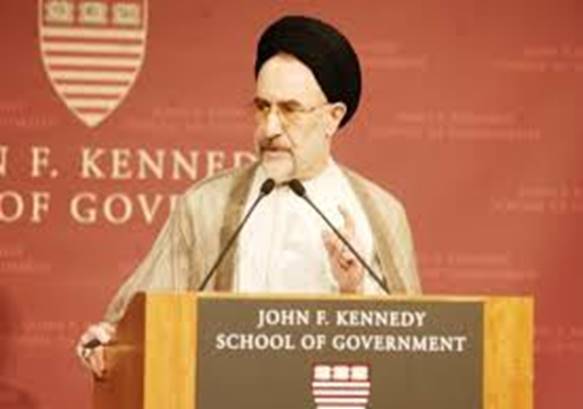
Khatami made a sincere effort to reach out to the US and improve relations with the American people – Photo The Harvard Crimson
Khatami, as discussed above, made a sincere effort to reach out to the US and improve relations with the American people. He hoped that his presidency could lead to a new era in relations between both countries. Speaking of relations between Iran and the US, Khatami said, “When we say that there exists a high wall of mistrust between us and the US, it is not a mere slogan. The Iranian people feel that Americans have dominated our destiny, at least, from 28th Mordad 1332 (9 August 1953) [the date of the CIA-backed coup to overthrow Iranian Prime Minister Mohammad Mosaddeq] until now…A lot of people suffered as a result of that unpopular (Pahlavi) regime [the Shah of Iran]. We were left behind by the rest of the world.”
Observing contemporary American foreign policy, Khatami interpreted it as having a continuing “cold war mentality,” oriented against a “perceived enemy.” While he noted the presence of “quite a few wise and fair-minded statesmen in the United States,” he believed the country was still a “prisoner” of this mentality, despite the collapse of communism. There was now what Khatami called “an attempt by certain circles to portray Islam as the new enemy, and regrettably they are targeting progressive Islam rather than certain regressive interpretations of Islam. They attack an Islam which seeks democracy, progress and development; an Islam which calls for utilization of achievements of human civilization including that of the West.”
Khatami further made overtures towards the US and the West when he declared the crisis involving Salman Rushdie, who Khomeini had sentenced to death for writing his novel The Satanic Verses, “completely finished.” Khatami’s foreign minister stated that Iran did not intend to carry out the sentence and that the government disassociated itself from the bounty of $2 million placed on Rushdie’s head by an Iranian foundation.
Tazmini, Khatami’s Iran, p. 108.
Tazmini, Khatami’s Iran, pp. 107-108.
Shakibi, Khatami and Gorbachev, p. 327.
Christopher de Bellaigue, “The Struggle for Iran,” The New York Review of Books, December 16, 1999.
Tazmini, Khatami’s Iran, p. 107.
Amuzegar, “Khatami’s Legacy,” p. 66.
Tazmini, Khatami’s Iran, p. 109.
Michael Rubin, Into the Shadows: Radical Vigilantes in Khatami’s Iran, Policy Papers no. 56. (Washington, DC: The Washington Institute for Near East Policy, 2001), p. 64.
Rubin, Into the Shadows, p. 73.
Tazmini, Khatami’s Iran, p. 110.
Shakibi, Khatami and Gorbachev, p. 243.
Rubin, Into the Shadows, p. 75.
Rubin, Into the Shadows, pp. 75-76.
Rubin, Into the Shadows, p. 108.
Shakibi, Khatami and Gorbachev, p. 312.
Shakibi, Khatami and Gorbachev, pp. 308-312.
Shakibi, Khatami and Gorbachev, p. 312.
Shakibi, Khatami and Gorbachev, p. 315.
Shakibi, Khatami and Gorbachev, p. 212.
“Transcript of interview with Iranian President Mohammad Khatami,” CNN, January 7, 1998.
“Transcript of interview with Iranian President Mohammad Khatami,” CNN, January 7, 1998.
“Transcript of interview with Iranian President Mohammad Khatami,” CNN, January 7, 1998.
Shaul Bakhash, “Iran’s Unlikely President,” The New York Review of Books, November 5, 1998.
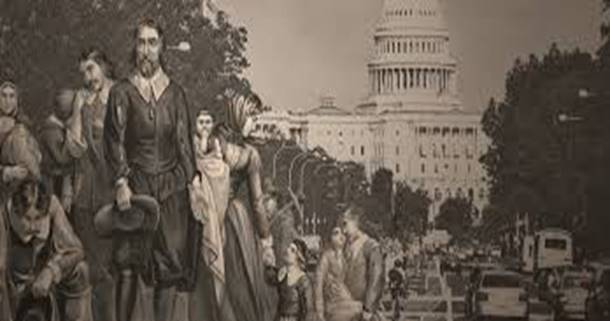
Discussing the Puritans and Alexis de Tocqueville in a CNN interview, Khatami pointed to the fact that the US is a religious society which nonetheless has a great degree of freedom, which was the essence of Khatami’s vision for Iran. As Khatami said, in the US, “liberty found religion as a cradle for its growth, and religion found protection of liberty as its divine calling” and he affirmed, “We feel that what we seek is what the founders of American civilization were also pursuing four centuries ago – Image Acton Institute
Through the framework of his “dialogue among civilizations,” Khatami said that Iran could learn from the US, especially in the area of freedom. Discussing the Puritans and Alexis de Tocqueville in a CNN interview, Khatami pointed to the fact that the US is a religious society which nonetheless has a great degree of freedom, which was the essence of Khatami’s vision for Iran. As Khatami said, in the US, “liberty found religion as a cradle for its growth, and religion found protection of liberty as its divine calling” and he affirmed, “We feel that what we seek is what the founders of American civilization were also pursuing four centuries ago.” Khatami additionally expressed his “regret” at the Iranian hostage crisis, in which over fifty Americans were held by Iranian supporters of Khomeini from 1979 to 1981, stating, “I do know that the feelings of the great American people have been hurt.” Khatami also spoke about his respect for Americans in history, describing President Abraham Lincoln, for example, as a “martyr,” a statement for which he was criticized by Iranian conservative hardliners.
When the 9/11 attacks took place, huge crowds in Tehran held candlelight vigils for the victims and Khatami expressed his “deep sorrow and sympathy with the American people.” Khatami decided to help the US in Afghanistan, hoping this would help improve relations, and contributed intelligence to the US for use against the Taliban. Iran also cooperated with the US at the Bonn Conference in December 2001 which charted a post-Taliban Afghanistan. Iran played a pivotal role when it influenced its Afghan ally the Northern Alliance to back down from demanding a monopoly of seats in the Afghan interim government, and also pressed the Northern Alliance to allow Hamid Karzai to assume the Afghan presidency. Iran furthermore pledged $530 million for reconstruction in Afghanistan, “a huge sum given the state of Iran’s economy and budget.”
In his State of the Union address in January 2002, however, President Bush identified Iran, Iraq, and North Korea as being part of an “Axis of Evil.” The reaction in Iran was fierce, creating more internal pressure on Khatami, and he took Bush’s inclusion of Iran in this grouping “as a rebuff to his attempts to create dialogue between Tehran and Washington and as a personal insult.” Khatami kept working with the US, however, in Afghanistan, and he also offered to assist the US in Iraq. The Bush administration rejected Iran’s offer, however. Iran’s elite, including reformists and moderates, became increasingly convinced that the US “was only after regime change and transformation of Iran into a client state.”
Khatami gave a bleak assessment of the impact of Bush’s speech, explaining, “the problem of designating Iran [a member of] the axis of evil took our relations to a situation which was perhaps worse than that which existed at the beginning of the Revolution and the peak of hostilities between Iran and America.” The “Axis of Evil” had a long-term impact on Iranian thinking and strategy, with Iran launching what it called its “Axis of Resistance” in response which included Hezbollah in Lebanon, Hamas and Islamic Jihad among the Palestinians, Shia militias in Iraq, the Syrian government headed by Bashar al-Assad, and the Houthis of Yemen.
Waving the green banner: Khatami out of office
The pressures facing Khatami domestically and from abroad intensified as public opinion began to shift away from the reformers. In 2005, he ended his second consecutive term in office, the maximum permitted by the constitution, and the next election was won by Mahmoud Ahmadinejad, a hardliner and the mayor of Tehran. Ahmadinejad represented, a scholar reported, “a different interpretation of Khomeinism that rejected the entire basis of Khatami’s understanding of it.” Ahmadinejad took a confrontational position in relation to the US, and enjoyed support from the precise quarters of society which had opposed Khatami and the reformers. Within months of Ahmadinejad’s election, Khatami “warned of a ‘fanatical’ interpretation of Islam.” In 2006, Khatami along with other senior leaders formed a coalition “in concern over both the radicalism of Ahmadinejad and growing US pressure focused on Tehran’s nuclear program.”
In 2009, Khatami decided to challenge Ahmadinejad for the presidency. When former Prime Minister Mir-Hossein Mousavi announced he would run as a reformer, however, Khatami dropped out and endorsed Mousavi to avoid splitting the vote and “to demonstrate that the wave of hope in society does not refer to a specific person (Khatami), and it is not just a passion or emotional excitement in the society; instead, people are aware, and they deliberately and consciously follow a specific way of change.”
Khatami gave Mousavi a green sash, an image widely circulated and memorialized in posters, and the “Green Movement” for reform in Iran took its name from this sash. While Khatami campaigned extensively for Mousavi, Ahmadinejad was again declared the winner, 63 percent to 34 percent. Mousavi then said that the vote had been rigged, and the largest protests since the 1978-79 Revolution broke out, which were crushed by the authorities—Ayatollah Khamenei claimed that the vote had not been rigged. Khatami backed the protestors, stating, “A velvet coup d’état against the people and democracy has taken place…The People’s protests were crushed and those who hold responsibility to protect the rights of the people, humiliated them.” Following this crisis, the conservative security apparatus consolidated, and the Revolutionary Guard expanded, for example controlling a third of Iran’s economy by 2010. In response to Khatami supporting the protestors, the government banned him from making public appearances and from traveling abroad.
Following Ahmadinejad’s second term, another Khatami-backed reformer arose to contest the presidency, the cleric Hassan Rouhani, who had served in senior national security posts and was Khatami’s lead international negotiator over Iran’s nuclear program. Under Khatami, Iran had agreed to suspend the enrichment of uranium and allow increased inspections. Khatami argued that “as Muslims, our religious faith should not allow us to seek nuclear weapons…The Islam I know does not have a use for them,” and shortly after leaving office called for a global religious movement against weapons of mass destruction: “It is the duty of the entire religious community to save the world from atomic bombs and chemical weapons.”
Rouhani, who had a PhD from a Scottish university, won the election, and went on to strike a landmark nuclear deal with the United States and international community in 2015 which limited Iran’s nuclear program. Rouhani also took his cue from Khatami in making grand gestures at the UN, calling for a “World against Violence and Extremism” and announcing the “Coalition for HOPE” (Hormuz Peace Endeavour) to address security in the Persian Gulf. Many officials from Khatami’s administration returned to serve in Rouhani’s cabinet.
Iranian security forces tightened restrictions on Khatami, despite Rouhani holding the presidency. In 2015, Iranian news media were banned from mentioning Khatami’s name or publishing his picture. In 2016, Rouhani publicly called for this ban to be rescinded, describing it as “illegal,” and in 2017 Rouhani criticized Iranian judicial officials after they prevented Khatami from leaving his home and meeting with political allies, rendering him under a sort of house arrest. In 2020, Khatami was able to make a rare public statement in which he warned that protestors might grow violent in frustration and despair, which would lead the government to respond, resulting in what Khatami called a “cycle of reciprocal violence between the people and the government” which would only “cause more hatred and violence on both sides, creating numerous complications. ”
In 2021, another conservative cleric, Ebrahim Raisi, who unsuccessfully challenged Rouhani in 2017, was elected president. Under Raisi widespread protests again broke out after Mahsa Amini, a 22-year-old Kurdish woman, was detained by morality police, allegedly for not wearing a hijab. She died in government custody, with her family claiming she was beaten by authorities. Amini’s death instigated an outpouring of public anger, with protestors chanting “Woman, life, freedom.” Once again, the protests were crushed by security forces, with an estimated 500 people killed and 19,000 arrested. Khatami voiced his hope that “nonviolent civil methods [will] “force the governing system to change its approach and accept reforms,” and attested, “Iran and Iranians need and are ready for a fundamental transformation whose outline is drawn by the pure ‘Woman, life, freedom’ movement”—it was, Khatami said, a “beautiful slogan.” Khatami called on Raisi’s government to “recognize the wrong aspects of
Brumberg, Reinventing Khomeini, p. 234.
Patrick Clawson, “The Khatami Paradox.” In Patrick Clawson, Michael Eisenstadt, Eliyahu Kanovsky, and David Menashri, Iran Under Khatami: A Political, Economic, and Military Assessment (Washington, DC: The Washington Institute for Near East Policy, 1998), p. 4.
Kourosh Ziabari, “Iran’s Khatami will soon be missed by the West,” Asia Times, January 8, 2022.
Seyed Hossein Mousavian and Shahir ShahidSaless, Iran and the United States: An Insider’s View on the Failed Past and the Road to Peace (New York: Bloomsbury Academic, 2014), p. 243.
Shakibi, Khatami and Gorbachev, p. 213.
Shakibi, Khatami and Gorbachev, p. 214.
Shakibi, Khatami and Gorbachev, p. 215.
Shakibi, Khatami and Gorbachev, p. 214.
Shakibi, Khatami and Gorbachev, p. 216.
Shakibi, Khatami and Gorbachev, p. 216.
Shakibi, Khatami and Gorbachev, p. 218.
Maysam Behravesh, “Iran’s Reform Movement: The Enduring Relevance of an Alternative Discourse,” Digest of Middle East Studies, vol. 23, no. 2, 2014, p. 275.
Shakibi, Khatami and Gorbachev, p. 335.
Gareth Smyth, “Iran’s Khatami strikes back,” The Guardian, September 19, 2013.
Gareth Smyth, “Iran’s Khatami strikes back,” The Guardian, September 19, 2013.
Samira Ghoreishi, Women’s Activism in the Islamic Republic of Iran: Political Alliance and the Formation of Deliberative Civil Society (Cham, Switzerland: Palgrave Macmillan, 2021), p. 154.
Shakibi, Khatami and Gorbachev, p. 356.
Mark Gregory, “Expanding business empire of Iran’s Revolutionary Guards,” BBC News, July 26, 2010.
Erin Cunningham, “Security forces reportedly bar Iran’s popular ex-president from leaving his home,” The Washington Post, October 19, 2017; “Iran’s Ex-Reformist President Banned From Public Appearances Week After Seven MPs Sentenced to Prison,” Center for Human Rights in Iran, October 8, 2017: https://iranhumanrights.org/2017/10/irans-ex-reformist-president-banned-from-public-appearances-week-after-seven-mps-sentenced-to-prison/
“Timeline: The U.S., Iran and the Nuclear Question,” NPR, August 25, 2009.
“Iran leader says nuclear bomb would be un-Islamic,” CNN, December 11, 2003.
“Khatami urges religious leaders to save world from nuclear weapons,” Mehr News Agency, November 15, 2005.
Shabnam Holliday and Edward Wastnidge, “Towards a post-imperial and Global IR?: Revisiting Khatami’s Dialogue among Civilisations,” Review of International Studies, vol. 51, no. 1, 2025, p. 74.
Gareth Smyth, “Iran’s Khatami strikes back,” The Guardian, September 19, 2013.
Thomas Erdbrink, “Iran’s President Flouts News Media Blackout Against a Predecessor,” The New York Times, March 7, 2016.
Erin Cunningham, “Security forces reportedly bar Iran’s popular ex-president from leaving his home,” The Washington Post, October 19, 2017; “Khatami Not Allowed to Leave His House to Attend a Public Event,” Radio Farda, February 25, 2018.
“Iran’s Ex-President Warns of a Cycle of Violence Between People and Government,” Radio Farda, May 10, 2020.
“Monitor: 516 Killed Since Iran Protests Began,” VOA Persian, January 3, 2023.
“Former Iranian President Khatami Joins in Calls for Political Change Amid Growing Unrest,” Radio Free Europe/Radio Liberty, February 5, 2023.
David Gritten, “Iran protests: Ex-president Khatami says rulers must heed protesters’ demands,” BBC News, December 6, 2022.
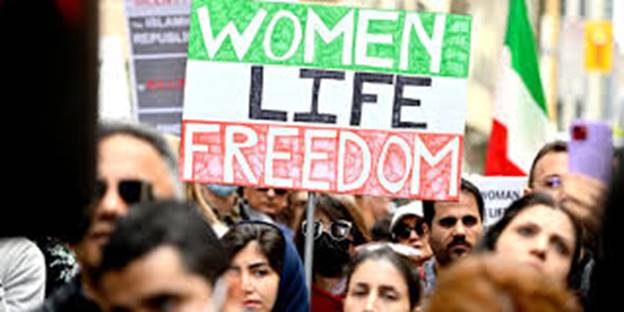
Khatami voiced his hope that “nonviolent civil methods [will] “force the governing system to change its approach and accept reforms,” and attested, “Iran and Iranians need and are ready for a fundamental transformation whose outline is drawn by the pure ‘Woman, life, freedom’ movement” - Photo Le Monde
governance and move towards good governance before it is too late.” In August 2023, a newspaper affiliated with Ayatollah Khamenei accused Khatami of “betraying the nation,” stated he was a “pawn for external forces seeking to overthrow the regime,” and called for his prosecution.
Following Raisi’s death in a 2024 helicopter crash, Khatami backed Masoud Pezeshkian, who had served under Khatami as Minister of Health and Medical Education, as the reformist candidate in the next election. Pezeshkian won, but his election came amid a decline in the power of the presidency and the outbreak of the Middle East crisis which steadily worsened following the Hamas October 7 th attack on Israel and Israel’s devastation of Gaza. Throughout the turmoil, Khatami continued to emphasize dialogue, including a May 2025 statement in which he said, “Negotiation and engagement are not signs of submission to the coercion of enemies.”
Currently, Iran is essentially in a state of war with the US and Israel—a war in which most of the surrounding countries including the Arab Gulf States have become embroiled. Many senior Iranian leaders including Ayatollah Khamenei have been assassinated in airstrikes, an act condemned by Khatami. Khamenei’s killing, Khatami said, was “a grave crime and a deeply painful tragedy for Iran’s present and future.” The US and Israeli strikes, Khatami further stated, have targeted “Iranian officials and citizens, including children.”
With great uncertainty about the future course of Iran both internally given its political divisions and concerning its international relationships, Khatami supported negotiations. “Lasting peace is the other face of heroic and comprehensive defense,” he said in April 2026, “It is greater than the mere absence of war. It requires genuine dialogue, logical negotiation, and a wise agreement—and it must encompass all parties, including political, social, and economic actors.” “Iran has entered a new and more sensitive phase,” he further affirmed, “We must, away from momentary euphoria, consolidate military and political victories and move toward a future in which all people participate with dignity in rebuilding the country.”
The trajectory of Khatami’s career is striking. We recognize in it the revolutionary nature of his reform program, the manner in which he stepped aside from actively leading it while remaining its most esteemed spiritual leader, and how important Khatami’s example remains for the future of Iran at this delicate time in which so many of the conventions which have held since 1979 have been shattered.
While academics and commentators have debated about whether Khatami’s presidency was a success or not, given the strengthening of the conservative position in Iran after he left office, it is clear that the importance of Khatami for Iran does not only lie in his actions while in office. Khatami himself lamented after leaving office, “despite reaching a global audience, the message of dialogue barely penetrated the most intractable political dilemmas, either at home or abroad.” “Today in universities, in our schools, and at home,” Khatami said, “we are incapable of exercising tolerance toward one another. Let us not doubt that unless we undergo an inner transformation, we cannot expect external forces to solve our problems for us.”
While some have called Khatami a failure, observers and scholars have noted the enduring impact of his presidency on Iranian society, including the framework for democracy in Iran which he established, and the manner in which he altered the terms of the debate and the nation’s political culture which was now being shaped by civil society and not only by the state. Fatemeh Haghighatjoo, an Iranian female member of parliament, contended that Khatami “brought to the fore such concepts as patience, tolerance, dialogue, questioning and answering, mutual respect and democratic family relations. More broadly, she argues, he changed the traditional master/follower relationship and introduced aspects of a democratic culture.”
For the scholar Golnar Mehran, “Khatami will be remembered for opening the doors of tolerance, kindness, and culture for a new generation of Iranians.” The scholar Arshin Adib-Moghaddam has pointed to Khatami’s unleashing of “pluralistic momentum” which he contends “was not limited to a single institution, political party or even a set of ideological currents.” The Iranian anthropologist Faribah Adelkhah described Iran under Khatami as “a society engaged in full-scale internal debate,” and this debate has continued to rage in the country. Khatami remains a major presence, even with the restrictions he faces.
And yet, the debates in which Iran has been embroiled are not so different in many ways from those taking place around the world. In each society we observe forces which seek to draw hard barriers and walls around the religious, ethnic, racial, or national community to protect identity from perceived threats, and those advocating more openness and tolerance, particularly towards the “Other.” It is to this latter position—which Khatami embodies—that we now turn.
Khatami on God and unity
Before discussing Khatami’s views concerning the “Other,” it is important to state first his views on God and the divine because Khatami approaches the “Other” from a perspective of common unity. All humans are united, Khatami affirms, in their “divine origin” and constitute a “single entity.” Khatami cites the Prophet of Islam and the thirteenth century Sufi poet Saadi to make the point: “Human beings, who in Saadi’s eloquent description borrowed from a saying of the holy Prophet of Islam, are various organs of the same body.”
The unity of humanity is but a reflection, Khatami teaches, of the unity of “the center of being” and the “source,” which he defines as “a God that is magnificent and majestic. Humans are in love with it but also reverent toward it.” Khatami refers to God as “the loved one” and describes the awareness of God as “Erfan,” using the Sufi term for the understanding of the unitary divine reality. Love for Khatami is thus a crucial reflection of the unity of reality in God, as is kindness, and he identifies “empathy, compassion and understanding” as binding the different cultures and civilizations of the world together.
As humans, we all are in a similar position of seeking to understand the unity we are a part of and get closer to an awareness of God, which is associated with truth and love—as Khatami says, “Humans instinctively seek God.” We live, Khatami explains, “in a sea of mysteries and curiosity about being, dazzled by existence and all its complexity and intricacy.” While he notes that some modern Western philosophers, contemplating the enormity of being itself, believe that it is impossible for humans to understand it, Khatami believes that God can be understood “through the heart…through direct experiential contact,” an idea he states that “All religions have emphasized.” “The path of the heart” leads to truth, Khatami affirms, and “The truth of religious belief” involves “resignation before the grandeur of existence, and enchantment by the loved one.”
Khatami is clear, however, that his emphasis on love and the heart in understanding God “in no way denies the importance of philosophical and scientific intellect, especially in Islam,” only that unlike the limitless love of the heart, the intellect has “limitations” due to our partial understanding of reality. What we do have to make sense of the world and the divine, Khatami affirms, is reason: “In my view, reason is the common bond of all humans, a means of connecting to the world and to others, the same reason through which Plato and Aristotle communicated their views. Reason and intellect represent the only way of understanding this world, even though this understanding is too relative to guide us to ultimate truths.”
There is an association between humans using their God-given powers of reason and the manner in which different religious traditions have developed among humanity. The process and pattern of attempting to understand the divine unity is the point at which the religions of the world come together—as Khatami argued, “all the divine religions are not quintessentially different.” The differences between religions and peoples derive, Khatami explained, from “religious laws and codes of conduct that govern the social and judicial life of human beings” which have arisen over time. Some of these eventually assume “the veneer of sanctity and are viewed as being immutable” despite having arisen in a specific period. Yet Khatami teaches that “Faith can only bear the fruits of morality and peace when it is constantly flowing. It is with an ever-renewing stream of faith that one can love the world and one’s fellow man.”
Khatami describes humans as “earthly and historical creatures” whose “understanding of the truth changes with the passage of time and change of location.” He says, “knowledge evolves. At one time, men of knowledge have one understanding, while at another time their understanding evolves, or perhaps the former understanding is even negated and replaced by our present understanding…Thus a great portion of our understanding of the Book of God is limited to time and space.”
This process is also present in the case of Islam, as Khatami contends, “I believe one can never have understanding of the Qur’an and religion...new interpretations have appeared with varying frequency…As the Prophet said, the Qur’an contains seventy layers. He also said that different minds have different interpretations. In other words, ijtihad [interpretation] is one of the important pillars that can help the Islamic world in making new interpretations.”
Khatami believes that the same process occurs in “civilizations” which represent the cultures and worldviews that form over time in human societies—“Every civilization is based on a specific world-view which is itself shaped by a people’s idiosyncratic historical experience.” He further explains, “Civilization is an answer to the curiosity of humans who never stop questioning their world. The ever-changing needs of humans compel them to fulfill these needs, and civilization is the answer to the questions one faces…With each question that is answered and each need that is fulfilled, humans are confronted with new questions and needs.”
While different attempts to understand the divine unity appear and develop among different religions and civilizations over time, Khatami believes, this should not overshadow the common process by which these interpretations develop nor should it preclude understanding between traditions. Reason is very important because it enables us to attempt on a renewed basis to understand God and being in our own time informed by our own traditions. Through dialogue we can also communicate with others and benefit from their approaches in their own contexts. As God is associated with truth and unity, the greater understanding humans have, the more harmony there will be—and the inverse is also true: with a lack of understanding we devolve into discord and move away from unity. As Khatami says, “misunderstanding is itself one of the important factors that distances us from the truth and transforms people with understanding into people who are at war and in conflict with one another.”
Thus, Khatami’s ideal world is one where, as he explains, on one level we recognize and embrace the common unity of all, but we also recognize and embrace our differences in grappling with and trying to understand the world, and indeed we can benefit from encountering the different human approaches. We should pursue what Khatami called “unity in diversity…we want a world that has commonalties, co-existence, but that also has differences and variety.”
Khatami and the “Other”
When Khatami views people who are different—by categories including religion, ethnicity, culture, civilization, nation, or race—then, he is seeing them as part of the same unity. He understands the diverse traditions of humans to be the result of human beings attempting to understand the divine and live the best way they can. Human cultural diversity is thus a fact of nature and derives from our relative positions in relation to one another. As Khatami says, “people are by nature different; we do not all think alike, and we do not have identical interpretations”
Khatami repeatedly stresses our relative perspectives concerning religion and thus inability to access the “full truth.” While humans “have signs of the superior being in them,” he contends, they “must use their fallible intellect that nature has bestowed on them to deal with nature.” There is a “relativity of human understanding, even of religion,” Khatami argues, and “All the diversity among different traditions, views, and religions, and even among sects of the same religion is proof that no one can claim to understand all reality from all angles.”
Thus, “Given the multiplicity of views of religion over history,” Khatami asserts, “we must ensure that we do not think that our view of religion is the only one.” He similarly urged Iranians in his inaugural address as president, “We should all avoid considering our own understandings and interpretations as absolute.” While there are indeed “sacred matters,” he contended, “our interpretations of them are human. Only through this realization will humans open their minds to the experiences and innovations of others.”
David Gritten, “Iran protests: Ex-president Khatami says rulers must heed protesters’ demands,” BBC News, December 6, 2022.
“Calls for trial of former Iranian reformist President Mohammad Khatami,” Shafaq News, August 25, 2023.
Roxane Razavi, “Iran’s president appeals to Americans—but does his office still hold any real power?,” The Conversation, April 2, 2026.
“Former Iran president Khatami: Negotiation is not surrender; hope for reform must be preserved,” Iran Front Page, May 22, 2025.
“Khatami Condemns Assassination of Ayatollah Khamenei,” WANA News Agency, March 1, 2026.
“Khatami Condemns Assassination of Ayatollah Khamenei,” WANA News Agency, March 1, 2026.
“Khatami Condoles Kharrazi After Wife Killed in Tehran Strikes,” Iran Wire, April 3, 2026.
“Former Iranian President Khatami Backs Talks, Says Iran Is in a New Phase,” Kurdistan 24, April 15, 2026.
“Former Iranian President Khatami Backs Talks, Says Iran Is in a New Phase,” Kurdistan 24, April 15, 2026.
See, for example, Shakibi, Khatami and Gorbachev; Tazmini, Khatami’s Iran.
Mohammad Khatami, “Iran: This time, the west must not turn its back on diplomacy,” The Guardian, September 23, 2013.
Khatami, Islam, Liberty, and Development, p. 14.
Tazmini, Khatami’s Iran, p. 146; Shakibi, Khatami and Gorbachev, p. 351.
Tazmini, Khatami’s Iran, p. 137.
Mehran, “Khatami, Political Reform and Education in Iran,” p. 313.
Arshin Adib-Moghaddam cited in Tazmini, Khatami’s Iran, p. 146.
Christopher de Bellaigue, “The Struggle for Iran,” The New York Review of Books, December 16, 1999.
Mohammad Khatami, “Symposium: Islam, Iran and the Dialogue of Civilisations,” Global Dialogue, vol. 3, no. 1, 2001, p. 4.
Mohammad Khatami, “Statement by H.E. Mohammad Khatami, President of the Islamic Republic of Iran, before the 53rd Session of the United Nations General Assembly,” Pars Times, September 21, 1998: https://www.parstimes.com/history/khatami_speech_un.html
Mohammad Khatami, “Statement by H.E. Mohammad Khatami, President of the Islamic Republic of Iran, before the 53rd Session of the United Nations General Assembly,” Pars Times, September 21, 1998: https://www.parstimes.com/history/khatami_speech_un.html
Khatami, Islam, Liberty, and Development, p. 86.
Khatami, Islam, Liberty, and Development, p. 91.
Khatami, Islam, Liberty, and Development, p. 85.
Tazmini, Khatami’s Iran, p. 97.
Khatami, Islam, Liberty, and Development, p. 47.
Khatami, Islam, Liberty, and Development, p. 85.
Khatami, Islam, Liberty, and Development, p. 90.
Khatami, Islam, Liberty, and Development, p. 91.
Khatami, Islam, Liberty, and Development, pp. 90-91.
Khatami, Islam, Liberty, and Development, p. 46.
Khatami, Islam, Dialogue and Civil Society, p. 7.
Khatami, Islam, Dialogue and Civil Society, p. 7.
Khatami, Islam, Liberty, and Development, p. 48.
Khatami, Islam, Dialogue and Civil Society, p. 32.
Khatami, “Symposium,” p. 7.
Khatami, Islam, Dialogue and Civil Society, p. 4.
Khatami, “Symposium,” p. 8.
Khatami, Islam, Liberty, and Development, p. 51.
Khatami, Islam, Liberty, and Development, p. 30.
Khatami, “Symposium,” p. 5.
Fabio Petito, “The Global Political Discourse of Dialogue among Civilizations: Mohammad Khatami and Václav Havel,” Global Change, Peace & Security, vol. 19, no. 2, 2007, p. 108.
Khatami, Islam, Dialogue and Civil Society, p. 3.
Khatami, Islam, Liberty, and Development, pp. 92-93.
Khatami, Islam, Liberty, and Development, p. 88.
Khatami, Islam, Liberty, and Development, p. 88.
Khatami, Islam, Liberty, and Development, pp. 94-95.
Khatami, Islam, Liberty, and Development, p. 145.
Khatami, Islam, Liberty, and Development, p. 95.
People who do “take some realities to be absolute, transcendent, and holy” or believe themselves to be “absolutely ‘good’ while considering the other as absolutely ‘evil’” are in fact viewing reality “through the prism of the relativity of their own minds and bodies.” Humans should “concede their limitations” as fallible people interpreting religion, Khatami implores, and if they do not, a “catastrophe” could result whereby the “prescriptions of a few may come to be viewed as religiosity itself. A believer is seen only as someone who subscribes to this specific view. Many frictions have their root here.”
Thus to impose a uniform society would be contrary to the rules of nature and creation, and the sign of a “dead” society which will condemn itself to destruction. God has “created humans different,” Khatami affirmed, and “Those who wish to homogenize society, especially with directives and from above, are moving in a direction opposed to the course [intended by] creation.” The inherent diversity among humanity is not a burden or weakness but a “blessing” according to Khatami. In fact, he said, “human creativity is based on diversity.”
This approach to the “Other” has both philosophical and socio-political implications. First of all, it is a view of compete human equality. Because of each of our limited perspectives, we should not impose how we see the world on others—such thinking often leads to ideas of superiority, but, as Khatami says, “we are all humans and no one can consider him/herself as superior to others.” He is adamant that “We should not divide humans into first and second class people.”
As a politician and government official, Khatami stressed repeatedly the equality of all people in the state as having the same rights and emphasized tolerance, empathy, and respect for diversity and the “Other.” This included categories of difference including gender, and he spoke passionately about women’s rights, urging the government to, as he said, “prepare the ground for women to recognize their rights and capabilities, and acknowledge their merits” and that it is “wrong to regard women as inferior and second sex and men as first and superior sex.”
Khatami stated, the “worst society is one in which only a single voice is heard.” Invoking his central theme of “freedom” in society, Khatami defined freedom in this way: “freedom means freedom for the opponent,” a crucial part of what Khatami calls the “art of governance.” Khatami is aware that in many societies, minority groups are often given precisely this “second class” status for deviating according to various characteristics from the majority group. This was certainly true in Iran, and Khatami spoke inclusively of Iranian identity as incorporating both Muslims and non-Muslims, Shia and Sunni, and the various ethnic groups of the nation. People should be assigned responsibility, Khatami said, “if they are ‘capable, skilled, and trustworthy, no matter if they are Sunni, Shi’i, Kurd, or Baluchi.”
As noted above in the discussion of Khatami’s ideal city based in the example of Medina guided by the Prophet of Islam, Khatami attempted to move the Iranian society towards this inclusive model. As he argued, “Our civil society is not a society where only Muslims are entitled to rights and are considered citizens. Rather, all individuals are entitled to rights, within the framework of law and order.” Such statements were particularly notable given that Khatami was “one of the few officials of the Islamic Republic to pronounce formally that rights of citizenship should be expanded to non-Muslims.” Even “if these rights [of non-believers] are trampled by a believer,” Khatami said, “[the state] would confront the believer.”
Khatami also cited the example of Caliph Ali, the cousin and son-in-law of the Prophet and a central figure in Shia Islam as the first Shia Imam—Khatami stated, “Amir Al-Mu’menin Imam Ali (AS) enjoined his representative to observe the principle of justice and equality as regards all people and not Muslims only, for ‘they are of two groups; a group of them is your brothers in faith and the other is like you in creation.’”
Speaking further about minorities in Iran, Khatami asserted, “our Sunnis, Shi’is, Baluchis, Kurds, Turkomans, and Lurs can be proud only if Iran is strong and proud.” On the subject of the Baháʼí, who have suffered longstanding persecution in Iran, Khatami said, “Bahai or not, they are Iranian citizens and their rights ought to be protected. The president, who sees himself as responsible for the rights of Muslim citizens, also sees himself as responsible for the rights of Bahai citizens.” Khatami additionally voiced his support for federalism in Iran, an arrangement which would give minority areas more autonomy, as “the most desirable democratic form of government for Iran,” and as president attempted to expand the powers of local bodies such as local councils. While Khatami’s suggestion of federalism provoked accusations he was promoting Iran’s disintegration, minority voices such as Abdollah Mohtadi, the co-founder of the Iranian Kurdish Koumeleh party, supported Khatami’s comments, stating, “I believe federalism is a progressive idea which secures Iranian people’s rights and brings them closer to each other.”
Internationally, Khatami was a pathbreaking president in reaching out to the “Other.” He assumed office aware of Iran’s isolated status in the world and attempted to change this by tearing down what he called “the wall of mutual distrust” between Iran and other nations. As discussed above, he reached out to the US in substantial ways, and in 2006, the year after he left office, he became the highest-ranking Iranian official to visit the US since the taking of the American hostages at the US embassy—this meant that for the first time since that period the US was specifically welcoming an Iranian leader outside of the United Nations structure.
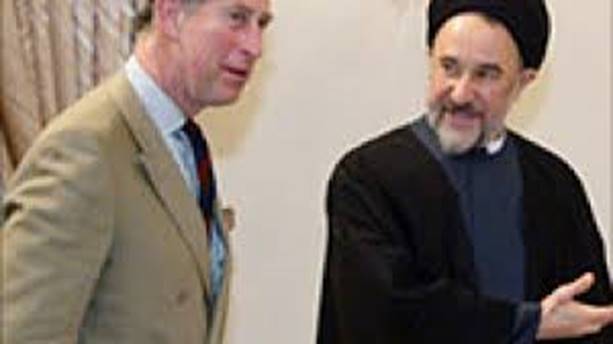
Khatami reached out to Western countries. As president he was the first head of state to visit France since the Iranian Revolution, and he welcomed Prince Charles to Iran after a devastating earthquake, the first British royal visit since the Revolution
Khatami also reached out to other Western countries. As president he was the first head of state to visit France since the Iranian Revolution, and he welcomed Prince Charles to Iran after a devastating earthquake, the first British royal visit since the Revolution. Khatami also had a private audience with Pope John Paul II and was welcomed by the King of Spain at his palace. Khatami additionally visited Vienna to build ties with the European Union. In Asia, Khatami was the first Iranian head of state to visit Japan in 40 years, where he met the Emperor, and in China he built economic ties. Given the often icy relations between Iran and Saudi Arabia, it was also a trailblazing move for Khatami to visit Saudi Arabia, where he became the first Iranian leader to visit since the Revolution.
While Khatami tirelessly promoted understanding and acceptance of the “Other,” he observed that global trends seemed to be moving away from embracing the “Other.” With globalization, he noted, had come an increased “identification with local cultures” as “local traditions have felt threatened and have therefore started a return to the ‘self.’” What they fear, Khatami discerned, was a “merging of cultures,” that their distinctiveness will be lost. Hence people who feel this way often focus on the “greatness” of their own identities, and obsess about supposed glories of the past. Here, Khatami says, it is necessary “to be able to critique your past” while attempting to understand it, which is important for self-identity. As societies are constantly in a state of flux and adaptation there can never be a true return to the past, he contends—learning about the past should be done not “to return to it and stagnate in it,” but to “understand the types of mentality and habits that are very much temporally and spatially relative…to find a foundation for the dignity of our today and a future that is even more glorious than our past.” Khatami calls this “moving towards the future while leaning on the past.” Then, he recommends, “We should automatically seek certain standards in the framework of which all peoples can live in understanding, but maintain their own values, without leading to any confrontation with others.”
The Dialogue among Civilizations
It was with passion and resolve that Khatami promoted his solution to help the world ameliorate the problems it faced: the dialogue among civilizations. He envisioned it as “a new basis on which to regulate human and social relations.” The dialogue among civilizations is deeply rooted in core elements of Khatami’s thinking discussed above—the unity of all, the respect for naturally occurring diversity, and the central role that our human, God-given reason plays in understanding the world, life, and the divine.
The dialogue among civilizations is the ultimate step for Khatami, a way to connect people of different backgrounds who each have their own religions, traditions, cultures, and civilizations. While humans are striving to understand God in their own way, and in the context of changing circumstances over time, Khatami believes that if multiple traditions are put in conversation and contact with each other, humans can grow closer to understanding God. In this sense, different perspectives are connected in a common endeavor, and with greater unity we can better approach the divine ideal. And yet, he always stresses that it is a unity in diversity—through diverse perspectives we are better able to approach and appreciate the unity.
Khatami believes that the dialogue among civilizations is both naturally occurring and a process that must be encouraged and facilitated, especially in the contemporary world where distances are growing smaller, we are grappling with transformative new technologies and scientific advances, and face new perils and dangers. The dialogue is naturally occurring because, as in Khatami’s discussion of Iranian identity, civilizations are the result of a dynamic process of interaction—they “ordinarily affect and transform one another.” He asserts, “no major culture or civilization has evolved in isolation.” On the subject of Islam and the West, for example, Khatami pointed out that after being “enriched in its golden age by Persian and Greek culture,” Islam “familiarized Westerners with their history of philosophy and civics. The transfer of Greek science, philosophy and wisdom first occurred as a result of Europeans’ familiarity
Khatami, Islam, Liberty, and Development, p. 89.
Holliday and Wastnidge, “Towards a post-imperial and Global IR?,” p. 172.
Khatami, Islam, Liberty, and Development, p. 89.
Khatami, Islam, Liberty, and Development, p. 89.
Mehran, “Khatami, Political Reform and Education in Iran,” p. 317.
Vahdat, Islamic Ethos and the Specter of Modernity, pp. 187-188.
Mehran, “Khatami, Political Reform and Education in Iran,” p. 317; “Khatami urges religious leaders to save world from nuclear weapons,” Mehr News Agency, November 15, 2005.
Brumberg, Reinventing Khomeini, p. 223.
Mehran, “Khatami, Political Reform and Education in Iran,” p. 317.
Mehran, “Khatami, Political Reform and Education in Iran,” p. 317.
Mehran, “Khatami, Political Reform and Education in Iran,” p. 318.
Mehran, “Khatami, Political Reform and Education in Iran,” p. 316.
Mehran, “Khatami, Political Reform and Education in Iran,” p. 319.
Mehran, “Khatami, Political Reform and Education in Iran,” p. 318.
Khatami, Islam, Dialogue and Civil Society, p. 18.
Vahdat, Islamic Ethos and the Specter of Modernity, p. 188.
Vahdat, Islamic Ethos and the Specter of Modernity, p. 189.
Khatami, Islam, Dialogue and Civil Society, p. 18.
Mehran, “Khatami, Political Reform and Education in Iran,” pp. 319-320.
Khatami, “Symposium,” p. 11.
“Former President’s Suggestion of Federalism for Iran Stirs Controversy,” Radio Farda, May 25, 2019.
“Former President’s Suggestion of Federalism for Iran Stirs Controversy,” Radio Farda, May 25, 2019.
Amuzegar, “Khatami’s Legacy,” p. 67.
Thom Shanker, “In Washington, Ex-President of Iran Calls for Tolerance,” The New York Times, September 8, 2006.
Tazmini, Khatami’s Iran, p. 86.
Khatami, “Symposium,” p. 12.
Khatami, “Symposium,” p. 12.
Mehran, “Khatami, Political Reform and Education in Iran,” p. 322.
Mehran, “Khatami, Political Reform and Education in Iran,” p. 322.
Vahdat, Islamic Ethos and the Specter of Modernity, p. 187.
Mehran, “Khatami, Political Reform and Education in Iran,” p. 321.
Khatami, “Symposium,” p. 12.
Khatami, “Symposium,” p. 1.
Khatami, Islam, Liberty, and Development, p. 49.
Khatami, Islam, Dialogue and Civil Society, p. 28.
with Muslims…The great Western civilization is strongly indebted to Islamic civilization.”
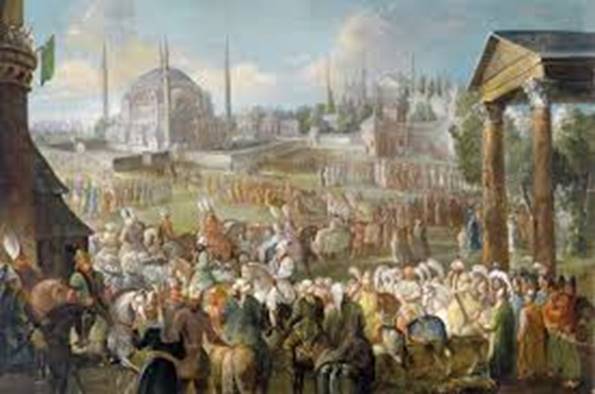
On the subject of Islam and the West Khatami pointed out that after being “enriched in its golden age by Persian and Greek culture,” Islam “familiarized Westerners with their history of philosophy and civics. The transfer of Greek science, philosophy and wisdom first occurred as a result of Europeans’ familiarity with Muslims…The great Western civilization is strongly indebted to Islamic civilization.”
It was notable, Khatami said, that the great Sufi mystic Ibn Arabi influenced Dante, and in turn, “in our schools of philosophy, the views of Plato, Aristotle, and Plotinus, and those of Descartes, Kant, Hegel and Wittgenstein from among the modernists are taught alongside the views of al-Kindi, Farabi, Ibn Sina (Avicenna), Suhrawardi and Mulla Sadra. If the great civilizations of Asia view themselves today in a Western mirror and get to know one another through the West, it was Islam that served in the not-too-distant past as a mirror to the West.”
In this important matter of cross-cultural influences, Khatami argued, recognition is important—otherwise people will not understand how the process has worked and may think that there were no external links. Speaking of the idea of tolerance, Khatami noted, “It is ironic that this concept of tolerance that was adopted from the Muslims and is a result of the contacts made by Europeans with them, is now, in our time, being offered by Europeans to Muslims as an ethical and political piece of advice. Evidence of the Muslim influence in the creation of this spirit of tolerance among Europeans is clear and can be traced in Europe’s literary history.”
Discovering such connections is itself part of the dialogue among civilizations which scholars and learned people can help the wider public appreciate. Khatami advises that discussing such connections should proceed even despite harmful processes such as colonization which have given the “West” a bad name in much of the world—he reminds his audience that the West is more than the colonialism, aggression, and imperialism that has occurred.
Conversely, some see the West as superior and believe that Eastern or non-Western cultures have little to contribute, or believe that in an age of globalization the world must “develop” precisely along the Western model. In contrast, Khatami counsels, “wherever hate or infatuation arises, the ability to know and critique a truth is lost. If the East can rise above this problem and begin to separate the intellectual and valuable aspects of the West from its political aspects, I believe that Easterners can better critique Western civilization. But Easterners should not be so prejudiced as not to critique their own tradition as well.” There is no reason the dialogue cannot continue, and he calls on Islamic civilization “to absorb the positive aspects of Western civilization.” “Our society needs to evolve and transform itself,” he says, “but we must know that development in its Western sense is merely one form of transformation, not the only form.”
In addition to such past examples of the dialogue among civilizations and intercultural and religious contact occurring organically—“as naturally and persistently as the emigration of birds in nature” as he put it—Khatami also promotes the dialogue as a conscious method and process. It is an interaction ultimately between “self” and “other” which aims at understanding, not only about the “other” but about the “self.” As Khatami explains, “Knowledge of the other makes us more knowledgeable about the self and knowledge of the self-enhances our knowledge of the other.” Khatami teaches, referring to the impact of dialogue on the self, that “Seeing in essence requires taking distance in perspective, and distance provides the grounds for immersion into another existential dimension…Dialogue is a bilateral or even multi-lateral process in which the end result is not manifest from the beginning. We ought to prepare ourselves for surprising outcomes, since every dialogue can provide grounds for human creativity to flourish.”
Furthermore, by speaking and listening to one another we are better able to contemplate and appreciate the unity and being of which we are all a part, and how each understands and makes sense of that unity. Khatami phrases it like this in his piece for my book After Terror: “Speaking and listening…are efforts by two or more parties aimed at coming closer to truth and achieving understanding…dialogue…reveals its beautiful but veiled face only to those aspirants who march hand in hand and shoulder to shoulder with other human beings…In effective dialogue among civilizations, listening is as important as speaking.”
Engaging in interfaith dialogue specifically is an important part of the dialogue among civilizations for Khatami. While religions have their own theological understandings and figures they hold sacred, the goal of dialogue is not to challenge these understandings and figures but to learn from and recognize one another with empathy. As an example, Khatami discusses the distinctions between the three Abrahamic religions of Judaism, Christianity, and Islam. Jews, Khatami says, “believe the messiah has not yet come,” while Christians “do not believe in a messenger after Christ.” Speaking from an Islamic perspective, Khatami said, “We see one root in all divinely inspired religions and believe all Abrahamic religions have the same nature.” Khatami thus reminds Muslims of how
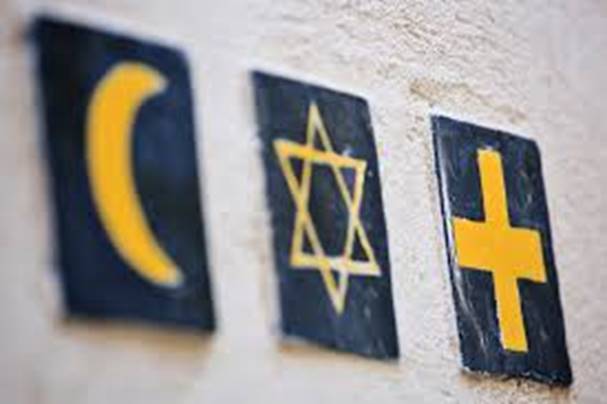
Khatami discusses the distinctions between the three Abrahamic religions of Judaism, Christianity, and Islam. Jews, Khatami says, “believe the messiah has not yet come,” while Christians “do not believe in a messenger after Christ.” Speaking from an Islamic perspective, Khatami said, “We see one root in all divinely inspired religions and believe all Abrahamic religions have the same nature.” – Image Boston University
the Abrahamic religions are seen in Islam to stress commonalities while hoping the other Abrahamic faiths “can “recognize Muslims, as Muslims recognize them, so that understanding and, God willing, achievement of common standards is made possible.” In such a manner the dialogue between faiths can progress.
Khatami offered an ideal example of how the dialogue among civilizations can be conducted in the relationships between three great poets: Hafez of Persia, Goethe of Germany, and Allama Iqbal of India (in Iran he is known as Iqbal Lahori and considered the national poet of Pakistan of which he had dreamt but did not live to see). The links between these figures began, Khatami tells us, when Goethe encountered Hafez, reaching from Christian Europe across time and space to the Islamic Persian Orient of Hafez. Iranians consider Hafez as the Shakespeare of the Persian language and “the tongue of the hidden,” Khatami explains, due to Hafez’s ability to convey “the inner nature of our people.” In his inclusive mystic embrace Hafez has written some powerful verses in honor of Jesus: “I am a hole in a flute through which blows the breath of Christ: listen to this music.” For Khatami Goethe, in his poetry in honor of Hafez employs Hafez’s style, and “found ‘the tongue of the hidden’ and established contact with him.” Goethe did not become “the Other”—he remained German—but he collapsed the distance between Islam and Europe and East and West.
Similarly, Iqbal, who subsequently responded to Goethe in his poetry, did not become German or European but collapsed the distance between civilizations. Khatami notes that Iqbal, living under colonial rule, would have had a reason to condemn Europe, but he looked beyond the “colonial colors” of Western culture, to access its human essence. All these thinkers were connecting in a space beyond geographical categories, a common human space. Khatami states, “Goethe said, ‘The East is God’s, the West is God’s,’ and Iqbal, as if to indicate the origin of the German poet’s inspiration, adorned his Message of the East with the Qur’anic verse that ‘East and West belong to God.’ The objective of both poets is to show a point where East and West meet. The common point of contact, in both views, is the divine origin of humanity. The feeling of estrangement that East and West have towards each other will be dissolved when each stops viewing itself as an absolute phenomenon and sees its ‘self’ in relation to the ‘other’ and in relation to this common origin. That is how East and West help each other towards perfection.”
Now coming to his ultimate point of guidance to humanity using these examples, Khatami concludes, “If dialogue is to be propounded as a new chapter in the world it must transform its basis from negative tolerance to joint co-operation. No nation should be marginalized for any philosophical, political or economic reasons; one must not just tolerate others, but also work with them.” It is not merely curiosity that should drive the dialogue among civilizations, but a quest “to discover the truth and to find salvation, understanding and coexistence,” which ultimately will be possible only by embracing each other with kindness.
Respect is key, as “one conducts a dialogue only when one respects the other party and considers the other party as equal to oneself.” It should be carried out with “sympathy and affection” as a “genuine effort to understand others,” and “without the desire to vanquish them.” Thus Khatami does not have in mind the Orientalist relationship, for example, whereby “the East is treated as an object of study, rather than as ‘the other side’ of a dialogue,” and, he also urges, “We too, as Iranians, as Muslims and as Asians, need to take major steps towards gaining a true knowledge of the West, as it really is.” In a correctly conducted dialogue, Khatami teaches, we consider the different positions and “look for the common human element.”
Khatami, Islam, Dialogue and Civil Society, p. 2.
Khatami, Islam, Dialogue and Civil Society, p. 2.
President Mohammad Khatami, Dialogue Among Civilizations: A Paradigm for Peace. Edited by Theo Bekker and Joelien Pretorius. (Pretoria: Unit for Policy Studies, Centre for International Political Studies, University of Pretoria, 2001), p . 50.
Khatami, Islam, Dialogue and Civil Society, p. 11.
Khatami, “Symposium,” p. 8.
Khatami, “Symposium,” p. 8.
Khatami, Islam, Liberty, and Development, p. 68.
Khatami, Islam, Liberty, and Development, p. 35.
Seyyed Mohammad Khatami, “Presentation.” In UNESCO, Dialogue among Civilizations: The Round Table on the Eve of the United Nations Millennium Summit (Paris: UNESCO, 2001), pp. 26-27.
Khatami, “Symposium,” p. 3.
Khatami, “Presentation,” pp. 27-28.
Khatami, “Dialogue among Civilizations and Cultures,” p. 72.
Khatami, “Symposium,” p. 13.
Khatami, “Symposium,” p. 13.
Khatami, “Symposium,” p. 13.
Khatami, “Symposium,” p. 13.
Khatami, “Symposium,” p. 2.
Khatami, “Symposium,” p. 3.
Khatami, “Symposium,” pp. 3-4.
Khatami, “Symposium,” p. 4.
Khatami, “Symposium,” p. 3.
Khatami, Islam, Dialogue and Civil Society, p. 2.
Khatami, Islam, Dialogue and Civil Society, p. 33.
Khatami, Islam, Dialogue and Civil Society, p. 11.
Khatami, “Symposium,” p. 2.
Khatami’s dual modes of approaching God or truth—reason and love/the heart—are also applicable to his understanding of the dialogue among civilizations. While we have been largely discussing the use of reason in the exchange of different views, Khatami once again suggests that a dialogue of the heart may be the ultimate form of the dialogue. He contends that “dialogue, before anything else, is a search for emotional contact and sincere trust.’’
It is not a coincidence that the three great figures discussed by Khatami as exemplars of the dialogue, Hafez, Goethe, and Iqbal are all poetic artists, indicating the essential role the arts and matters of the heart have in the dialogue among civilizations. In an often-unforgiving environment, Khatami states, “we need the magical touch and spell of the enchanted artist and the inspired poet to rescue life—at least part of it—from the iron clasp of death” in a world “thoroughly controlled by political, military and economic conditions.”
In contrast to the prevalent discourse of international relations which consists of raw power, “realism,” and “national interests,” and the usual language of diplomacy which Khatami characterizes as “plastic,” meaning artificial and clinical, the dialogue among civilizations brings in an essential moral, humane, lively, dynamic, and ethical language and perspective to relations between states and peoples. In fact, Khatami argues, it is only the dialogue among civilizations which can achieve the goals that raw power realism purports to: stability and a stable world order. As Khatami puts it, “the paradigm of dialogue among civilizations requires that we give up the will for power and instead appeal to the will for empathy and compassion. Without the will for empathy, compassion and understanding there would be no hope for the prevalence of order in our world.” Civility, which is also crucial to living together, he says, “is contingent upon dialogue among societies and civilizations representing various views, inclinations and approaches.”
Khatami additionally contends that while it is possible to impose stability and peace through raw power and force, this is contingent “on the amount of force” employed and “whether the peace in question serves the interests of either party.” In contrast, peace achieved through dialogue is much deeper, loving, and long lasting. This peace “will depend on its own raison d’être as well as on the rational and psychological development of man…such a peace will definitely be long-term, with a very broad range, covering such fields as peace among cultures, peace among religions,” and “peace among civilizations.”
The dialogue of civilizations, then, is a paradigm for coexisting, for strengthening the bonds between us as we aspire to greater peace and unity. It is an attempt to make whole what may be broken or fractured. This also goes for the relationship between humans and nature, where Khatami observes the same ongoing process: “This rupture of intimate and ardent relations with nature has led to a weakening of similar relations among men.” Just as humans may see the “Other” as an object rather than a full subject, they also commonly see nature as a “source of energy” or “a mass of inert materials with different shapes”—in this case, the “communion” that humans have had with “the sea, the mountains, the forests and the deserts” for thousands of years is broken.
The goal here is “peace between man and nature,” which is part of what Khatami calls “Comprehensive peace,” an all-encompassing state “over and above peace among human beings.” Again, the dialogue can help achieve this peace: “The dialogue among cultures and civilizations which should be concerned with the most important and urgent problems that afflict all mankind should naturally place the problem of man’s relations with nature at the top of its agenda.”
Khatami’s lessons for our world
In 2026, following the start of the American and Israeli war with Iran, a revived internet meme of Khatami went viral in the United States. The meme consists of a still of Khatami from a CNN interview as he attempted to reach out to Americans, with his quote, “Alexis de Tocqueville…which I am sure most Americans have read” displayed in text. While Khatami is not identified in the meme, the image had resonance due to Khatami’s appearance in his spectacles, beard, turban, and clerical robes—he was effectively a stand in for Iran’s clerical leaders.
The irony was that Iran’s educated leaders may expect too much understanding from the American public. Not only do Americans commonly not understand Iran or appreciate the high levels of erudition among the leadership, but they similarly may not be as well versed in American and Western literature as Iranians might assume.
The meme gained added resonance when Iran’s negotiation team traveled to Pakistan for talks with the United States, and it was revealed that all four of Iran’s top negotiators—Abbas Araghchi, Iran’s foreign minister, Mohammad Bagher Ghalibaf, the speaker of the Iranian parliament, Ali Akbar Ahmadian, Iran’s security chief, and Abdolnaser Hemmati, the governor of Iran’s central bank—had PhDs, while no member of the US delegation consisting of Vice President J. D. Vance, Steve Witkoff, and Jared Kushner had a PhD.
The meme indicated there was an awareness among some Americans of the immense chasm of understanding between Iran and the US. It also contested the idea that the Iranian leadership consisted of ignorant “fanatics.” Abbas Araghchi’s PhD, for example, was in politics from England’s University of Kent and examined the relationship between Islamic governance and Western liberal democracy.
Currently, the relationship between the US and Iran is in uncharted territory. On the positive side, in Pakistan the two countries held their highest-level face to face talks since the Islamic Revolution in 1979. However, the scale of the US and Israeli strikes—the US alone carried out over 13,000 strikes on Iran before a ceasefire came into effect in April—and the high office of many of the targets, including Supreme Leader Khamenei, may only embolden the most hardline figures in Iran. Huge questions remain, for example, on the future and goals of Iran’s nuclear program, and the status of the Strait of Hormuz which is essential for the global economy and the world’s oil supply.
There is clearly a power vacuum at the top of the government which is being filled by aggressive, more confrontational forces, with the Iranian leadership now reportedly consisting of “a battle-hardened collective of commanders in the Islamic Revolutionary Guards Corps and those aligned with them.” The Revolutionary Guard has sidelined the Khatami-backed president, Masoud Pezeshkian, and told him “to focus only on domestic affairs, such as providing a steady flow of food and fuel.”
The dominance of such hardline figures was on display in Iran’s negotiation team which met Vance and the US team—two of the four top negotiators, Mohammad Bagher Ghalibaf and Ali Akbar Ahmadian, as senior Revolutionary Guard commanders in 1999, signed a letter threatening Khatami if he did not control pro-democracy protestors. They wrote, “Our patience is at an end. We do not feel it is our duty to show any more tolerance…Mr President, if you don’t take a revolutionary decision today, and fail to abide by your Islamic and nationalistic duty, tomorrow will be too late and the damage done will be irreparable and beyond imagination.”
If Khatami lamented Bush’s “Axis of Evil” for its detrimental effect on the possibilities of facilitating dialogue, tolerance, and reform in Iran, President Donald Trump’s apocalyptic threat to destroy Iran-- “A whole civilization will die tonight, never to be brought back again”-- and killing Supreme Leader Khamenei will make the task infinitely more complex and difficult. Perhaps those around Trump did not let him know that Persian civilization spreads far and wide beyond the borders of Iran and has penetrated deep into Central and South Asia and the Middle East.
The devastating attacks on Iran’s infrastructure including hospitals, colleges and archeological sites which began with the heartless slaughter of some 170 school girls in Minab has only served to unite the nation against what was an unpopular and shaky regime. The killing of the Supreme Leader has become a rallying point and symbol of nationalism not only for Shia Iranians but also for other Muslims throughout the Muslim world. Not only Muslim countries but in what is regarded as the Global South people have responded with enthusiastic admiration for Iran. Here is the former Supreme Court Justice of India, a prominent Hindu public intellectual (“A humble tribute to the greatest nation on earth today” by Justice Katju, Indicanews):
“For over 60 days since 28 February 2026, a day which will live in infamy, it was suddenly attacked by the US-Israeli forces … Iran has withstood that furious, unprovoked and treacherous assault of America, the mightiest nation on earth with the most powerful military… In my opinion it is only Iran, which has valiantly and heroically faced the mightiest military power in the world for over 60 days and has refused to surrender, (when France had surrendered to Germany in June 1940 in just 43 days), which can be that leader, and can, by the example of its own heroism and velour, inspire other underdeveloped nations to begin their own struggles for emancipation … That is why I regard Iran as the greatest nation on earth today.”
And yet, if the Middle East is to be brought back from the brink, and a better world built, Khatami’s example is extremely important. It is significant that however intense the pressure was on Khatami and his supporters and allies, who faced intimidation and violence, he never deviated from his peaceful approach of dialogue and negotiation, even with his fierce opponents. While the time of the peacemakers like Khatami may not have come yet, it may come from the debris of the current crisis. Khatami’s life and thought demonstrate clearly and conclusively the presence and durability of the reform camp in Iran and the deep desire for dialogue and openness, despite recent trends.
Iran, the Middle East, the West, and the world face similar challenges—a retreat to tribalism and closing off to the “Other,” the difficulties of reconciling tradition and modernity and religion and science, grappling with transformative and potentially dangerous technologies such as AI, and dealing with the perils of climate change and the possibility of the use of nuclear arms.
On all these issues, Khatami presents an approach to finding viable solutions, as we have endeavored to show in this piece. His paradigm of dialogue among civilizations should be revived and strengthened to pursue the ideal of a peaceful and loving world. It can be applied both internally and between nations and peoples, and as a framework to resolve significant problems concerning humanity as a whole such as protecting and healing the natural environment. To pursue a positive and inspiring ideal is not, as Khatami tells us, “an exercise in imagination but the panoramic outlook of a future situation, whose achievement is possible and for whose realization it is our urgent duty to strive.”
Khatami implores us to be hopeful, to pursue the ideal and attempt to make it a reality, arguing, “We must be brimming with hope for the future.” As “humanity has a common fate” and we are all “aboard the same ship,” Khatami says, we should aspire to a world of “mutual comprehensive cooperation.” A world where we move away from the use of violence, and as he put it, achieve “the final victory of the word over the sword.” We should “hope that in the coming century resort to force and violence shall not be glorified, and the essence of political power be compassion and justice, externally manifested in dialogue between civilizations.”
It is to have what Khatami calls “vivacious hope: the hope of living in a world permeated by virtue, humility and love.” Indeed, Khatami affirms, love is the answer: “We say we love all the people in the world and we want them to love us in return…Resentments should be turned into kindness and love.” While the prospect of the “cooperation of the entire human community” might sound “romantic,” Khatami said, “it is now an inescapable necessity for the survival of mankind.” We simply have no other choice.
We will close with Khatami’s prayer and dream captured in his powerful invocation of Hafez which reflects the splendor and grandeur of the thought of Ibn Arabi, Al Farabi, Goethe, and Iqbal: “Let us hope that all human beings will sing along with Hafez of Shiraz, that divinely inspired spirit: No ineffable clamor reverberates in the grand heavenly dome more sweetly than the sound of love.”- Photo PBS
We will close with Khatami’s prayer and dream captured in his powerful invocation of Hafez which reflects the splendor and grandeur of the thought of Ibn Arabi, Al Farabi, Goethe, and Iqbal: “Let us hope that all human beings will sing along with Hafez of Shiraz, that divinely inspired spirit: No ineffable clamor reverberates in the grand heavenly dome moresweetly than the sound of love.”
(Ambassador Akbar Ahmed is Distinguished Professor of International Relations and holds the Ibn Khaldun Chair of Islamic Studies at the American University, School of International Service. He is also a global fellow at the Wilson Center Washington DC. His academic career included appointments such as Nonresident Senior Fellow at the Brookings Institution; the First Distinguished Chair of Middle East and Islamic Studies at the US Naval Academy in Annapolis, MD; the Iqbal Fellow and Fellow of Selwyn College at the University of Cambridge; and teaching positions at Harvard and Princeton universities. Ahmed dedicated more than three decades to the Civil Service of Pakistan, where his posts included Commissioner in Balochistan, Political Agent in the Tribal Areas, and Pakistan High Commissioner to the UK and Ireland.
Frankie Martin is a doctoral candidate in anthropology at American University and a senior researcher for Akbar Ahmed’s quartet of Brookings Institution Press studies on Western-Islamic relations.
Amineh Ahmed Hoti is Fellow-Commoner at Lucy Cavendish College, University of Cambridge. She was also a senior researcher for Akbar Ahmed’s quartet of Brookings Institution Press studies on Western-Islamic relations. Her most recent book is Gems and Jewels: The Religions of Pakistan, 2021).
Petito, “The Global Political Discourse of Dialogue among Civilizations,” p. 110.
Khatami, “Presentation,” p. 28.
Khatami, “Dialogue among Civilizations and Cultures,” p. 76.
Khatami, “Dialogue among Civilizations and Cultures,” p. 76.
Khatami, “Presentation,” p. 26.
Mohammad Khatami, “Statement by H.E. Mohammad Khatami, President of the Islamic Republic of Iran, before the 53rd Session of the United Nations General Assembly,” Pars Times, September 21, 1998: https://www.parstimes.com/history/khatami_speech_un.html
Khatami, Islam, Dialogue and Civil Society, p. 32.
Khatami, Islam, Dialogue and Civil Society, p. 32.
Khatami, Islam, Dialogue and Civil Society, p. 33.
Khatami, Islam, Dialogue and Civil Society, p. 32.
Mohammad Khatami, “Statement by H.E. Mohammad Khatami, President of the Islamic Republic of Iran, before the 53rd Session of the United Nations General Assembly,” Pars Times, September 21, 1998: https://www.parstimes.com/history/khatami_speech_un.html
Khatami, Islam, Dialogue and Civil Society, p. 33.
“US-Iran talks in Islamabad: Who is involved and why it matters,” Dawn, April 9, 2026.
“Abbas Araghchi,” Encyclopedia Britannica: https://www.britannica.com/biography/Abbas-Araghchi
Dan Sabbagh, “Extended naval blockade is admission US military escalation poses even greater risk,” The Guardian, April 23, 2026.
Farnaz Fassihi, “A New Era and New Leadership: The Generals Who Are Running Iran,” The New York Times, April 23, 2026.
Farnaz Fassihi, “A New Era and New Leadership: The Generals Who Are Running Iran,” The New York Times, April 23, 2026.
“Iran’s top military leaders warn Khatami,” Associated Press, July 21, 1999.
“Trump says ‘a whole civilization will die tonight’ if Iran does not make a deal,” Reuters, April 7, 2026.
Shakibi, Khatami and Gorbachev, p. 328.
Khatami, Islam, Dialogue and Civil Society, p. 19.
Muhammad Khatami, Hope and Challenge: The Iranian President Speaks (Binghamton, NY: Institute of Global Cultural Studies, Binghamton University, 1997), p. 91.
Behravesh, “Iran’s Reform Movement,” p. 273.
Khatami, Islam, Dialogue and Civil Society, p. 34.
Behravesh, “Iran’s Reform Movement,” p. 273.
Mehran, “Khatami, Political Reform and Education in Iran,” p. 322.
Mohammad Khatami, “Statement by H.E. Mohammad Khatami, President of the Islamic Republic of Iran, before the 53rd Session of the United Nations General Assembly,” Pars Times, September 21, 1998: https://www.parstimes.com/history/khatami_speech_un.html
Gareth Smyth, “Iran’s Khatami strikes back,” The Guardian, September 19, 2013.
Elaine Sciolino, “Mullah Who Charmed Iranians Cannot Change Status Quo,” The New York Times, February 1, 1998.
Khatami, “Dialogue among Civilizations and Cultures,” p. 77.
Khatami, “Presentation,” p. 30.
