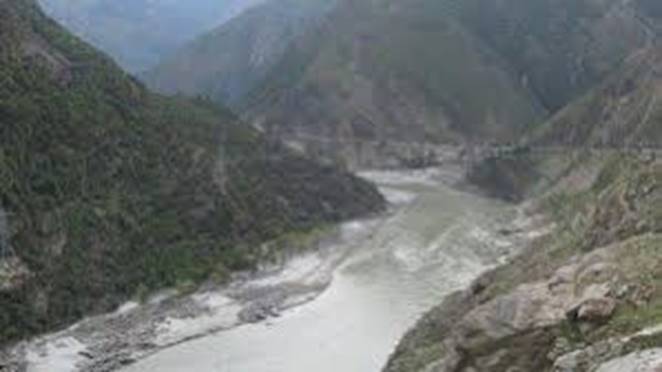
Where Will the Indus Water Go?
By Justice Markandey Katju
Former Judge
Supreme Court of India
Delhi, India

I saw this post on the website indicanews.com , which made me wonder how the suspension of the Indus Waters Treaty, 1960, could actually and practically be implemented.
https://indicanews.com/india-keeps-indus-waters-treaty-in-abeyance-marks-one-year-of-operation-sindoor/
The Indus Waters Treaty was suspended on April 23rd, 2025, by the Indian government after the Pahalgam attack and Operation Sindoor, which means that the water of the Indus and other western rivers will not be allowed to go into Pakistan.
https://www.newsecuritybeat.org/2025/06/suspending-the-indus-waters-treaty-what-it-means-and-why-it-matters/
The Indus Waters Treaty, 1960, signed by India and Pakistan provided that the waters of the three western rivers, the Indus, Chenab and Jhelum, would be under the control of Pakistan, while that of the eastern rivers, the Ravi, Beas and Sutlej, would be under the control of India.
https://mea.gov.in/bilateral-documents.htm?dtl/6439/Indus
https://en.wikipedia.org/wiki/Indus_Waters_Treaty
India is the upper riparian state, while Pakistan is the lower riparian state. Suspension of the Treaty means that the waters of the three western rivers will no longer be allowed to go to Pakistan. In other words, they will be diverted to India.
Leaving aside the question of legality of such suspension, how can such a suspension be actually implemented?
The waters of the three western rivers will not stop flowing, whether the Treaty is suspended or not. If such waters of the three western rivers are diverted into India, Indians will have to build dozens of huge structures like dams, barrages, reservoirs, etc. where such water can be stored, and hundreds of canals for sending it later to agricultural fields, cities in India, etc.
Presently India does not have such structures, and they will require hundreds if not thousands of crores of rupees to build and take many long years to construct. Until they are built (if at all they are built), suspension of the Treaty means nothing, and seems only a stunt and a gimmick for getting votes in Indian elections.
Moreover, diverting the course of a river is a superhuman task, which will cost thousands of crores of rupees, if at all it can be done. The course of a river is made by nature, not artificially, by geographical forces over thousands of years.
For example, the Jamuna River coming from the Himalayas flows from Delhi to Allahabad (Prayagraj), where it joins the Ganga. Can it be diverted so that it flows from Delhi to Rajasthan or Gujarat, instead of going to Allahabad? That would require digging deep underground passages hundreds of miles long, costing thousands of crores of rupees (assuming it can be done at all). The very idea seems ridiculous.
Apart from that, there is the humanitarian consideration too. Pakistan is already short of water, and there are often disputes between Pakistani Punjabis and Sindhis over water
https://thediplomat.com/2024/12/why-are-the-sindhis-protesting-in-pakistan/
https://theprint.in/world/tensions-escalate-between-pakistans-punjab-sindh-provinces-over-water-share/956495/
https://www.youtube.com/watch?v=1xrvNJO47TE
So, should India deprive Pakistanis of even the little water they have? Should Pakistan be turned into a Karbala, where Imam Husain and his family members and followers were deprived of water from the Euphrates River in the scorching heat in 680 AD? After all, Pakistanis are humans too.
https://www.facebook.com/matwproject/posts/do-you-know-why-water-means-more-in-muharram-in-karbala-water-wasnt-just-withhel/1282809516537150/
https://www.facebook.com/MuslimHandsCanada/posts/in-the-scorching-plains-of-karbala-even-a-drop-of-water-was-denied-to-the-family/1149542250553453/
(Markandey Katju is an Indian jurist and former judge of the Supreme Court of India who served as chairman of the Press Council of India from 2011 to 2014.)