
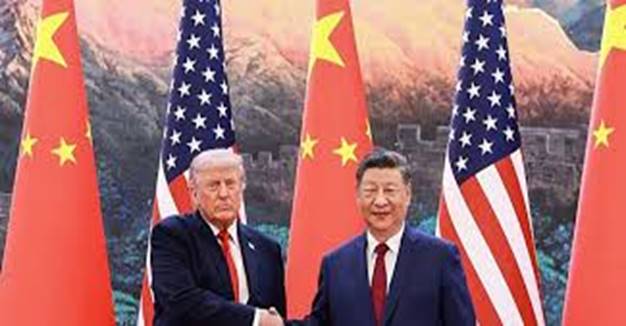
The handshake in Beijing may last only seconds on television. The consequences for Pakistan could last decades - Photo UPI
Trump’s China Visit Could Reshape Pakistan’s Future
By Arif Zaffar Mansuri
President
PL Publications
CA
Some meetings change headlines for a week. Others quietly change the direction of nations. Trump’s visit to Beijing may prove to be the second kind.
The images from Beijing looked almost theatrical. Red carpets stretched across the tarmac. Chinese schoolchildren waving American flags in a rehearsed rhythm. Donald Trump stood beside Xi Jinping under the bright lights of the Great Hall of the People, while military bands played and cameras flashed across the world.
But behind the ceremony was a far more serious reality.
The Iran conflict, Taiwan tensions, and collapsing trust between major powers have suddenly made countries like Pakistan strategically impossible to ignore.
Somewhere between Washington, Beijing, Tehran, and the Gulf sits Pakistan — a country that may soon find itself more strategically important than at any point since the War on Terror.
Why This Summit Matters
Trump’s visit marks the most consequential US-China summit in years. It was originally expected earlier, but tensions surrounding Iran and regional instability reshaped the meeting's timing and urgency.
That alone says something important.
The crisis in the Middle East can no longer be separated from America’s relationship with China.
Publicly, Trump framed the trip around trade, tariffs, manufacturing, and economic cooperation. He arrived with prominent American business leaders and pushed for expanded access to Chinese markets.
But Iran hovered over every meeting.
China remains one of the largest buyers of Iranian oil, and Washington understands that Beijing has influence in Tehran that few countries possess. Even as Trump projected confidence, American officials quietly acknowledged they needed China’s help to stabilize the Gulf and protect global energy routes.
That matters deeply for Pakistan.
Pakistan’s Delicate Balancing Act
For years, Islamabad has tried to avoid being trapped inside a rigid “choose one side” framework between China and the United States. It is easier said than done.
China is Pakistan’s largest strategic partner and the backbone of the China-Pakistan Economic Corridor. The United States remains essential for trade, diplomacy, global finance, military coordination, and the millions of Pakistani Americans who form a living bridge between both countries.
Over the past several months, Pakistan also tried to position itself as a stabilizing diplomatic actor during the Iran crisis. Pakistani officials coordinated closely with Beijing on calls for de-escalation and stability in Gulf shipping routes.
Islamabad understands that any widening regional conflict would hit Pakistan hard, economically and strategically.
Why Gwadar Matters More Than Ever
China increasingly sees Pakistan not only as an economic corridor, but also as a strategic connector between South Asia, the Middle East, and the Arabian Sea. Beijing understands that instability in the Gulf threatens Chinese energy security.
Pakistan, because of geography and relationships with both Iran and Gulf states, becomes valuable in ways that go far beyond roads and ports.
Gwadar is no longer viewed in Beijing as simply a development project.
In China’s long-term strategic thinking, it is part of a broader effort to reduce dependence on vulnerable maritime routes stretching through the South China Sea and the Strait of Malacca.
The Taiwan Factor
Washington’s calculations are changing too.
American strategists understand that any future confrontation with China — especially over Taiwan — would require stable alliances, secure supply chains, and regional partners capable of preventing broader instability.
During the Beijing summit, Xi reportedly warned Trump directly that mishandling Taiwan could lead to conflict.
Islamabad understood that message immediately, because every escalation between Washington and Beijing narrows the space for countries trying to maintain meaningful relations with both powers.
Pakistan has seen this kind of geopolitical competition before.
During the Cold War, Pakistan became central to America’s anti-Soviet strategy. After 9/11, Pakistan again became indispensable because of Afghanistan.
But this era feels different.
The competition is no longer only military. It is economic, technological, maritime, and political, all at once.
And unlike previous eras, Pakistan now has a far deeper relationship with China than it did with any major power during the twentieth century.
The Risks Ahead
For Pakistan, the opportunity is obvious.
So is the danger.
Pakistan today is economically weaker, politically more fragile, and operating in a far more dangerous region than it was during earlier geopolitical confrontations.
If tensions between Washington and Beijing continue rising, Islamabad could eventually face pressure from both sides.
Washington may push countries to reduce technological or strategic dependence on China. Beijing may expect stronger diplomatic alignment from close partners.
Pakistan’s leadership will have to navigate this carefully, because its economy cannot afford isolation from either camp.
There is another reality Pakistani policymakers understand well.
Instability in the Gulf directly affects ordinary Pakistanis. Rising oil prices damage Pakistan’s fragile economy almost immediately.
No government in Islamabad can ignore the fact that economic shocks born thousands of miles away can raise fuel prices overnight in Lahore and Karachi.
A Moment That Could Echo for Years
That is why Trump’s Beijing trip matters far beyond America and China.
It signals that even during confrontation, both powers still recognize the danger of pushing the international system too close to the edge.
But history is full of moments where leaders believed they could manage tensions — until events moved faster than diplomacy.
Pakistan now stands at the intersection of nearly every major geopolitical fault line shaping this century: China and America, Iran and the Gulf, trade and energy, diplomacy and conflict.
The two giants are shaking hands right now. Pakistan built the room.
The handshake in Beijing may last only seconds on television. The consequences for Pakistan could last decades.
(Arif Zaffar Mansuri is President of PL Publications, publisher of Pakistan Link and Urdu Link, and host of The Mansuri Show on ARY Digital TV. A veteran real estate investor, entrepreneur, industrialist, journalist, and community leader, he is dedicated to amplifying the voices of the Pakistani American community. Watch his show at YouTube.com/@MansuriShow or reach him at Salam@PakistanLink.com )
