
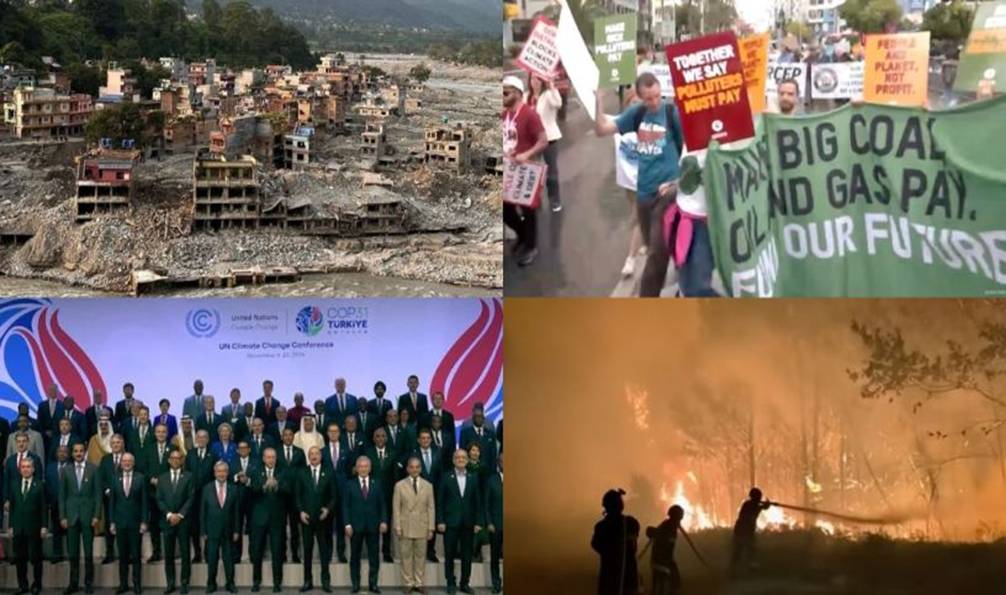
Clockwise: Devastating flashfloods in Nepal, protestors in Turkey demand polluters to pay, world leaders at the Climate Change Conference, fires in Spain and France. Decades of inaction has left the lowest emitters bearing the brunt of the climate crisis. As the world is set to cross the 1.5°C threshold, South Asia must build a stronger alliance
Will Nepal’s Tragedy Be the Wakeup Call at COP31?
By Shoaib Ahmed Sayam
Dhaka, Bangladesh

Arriving at the 31st United Nations Climate Change Conference known as COP31, in Antalya, Turkiye last week, activist Greta Thunberg launched an attack on the event itself.
Addressing the press and attendees, she said, “COPs have become greenwashed circuses .”
Thunberg vocalized a thought many carry about the summit: a gathering where world leaders talk endlessly about climate change before leaving with empty promises of action.
The U.S., the world’s largest historical emitter of greenhouse gases, doesn’t even pretend to care anymore. The Trump administration withdrew it from the Paris Agreement in 2020, then in 2025, moved to withdraw it from the 1992 UN Framework Convention on Climate Change (UNFCCC), the foundation of international climate negotiations.
This decades-long negligence has contributed to one disaster after another. A recent example is the ice-rock avalanche and the resulting flash floods in Nepal , which killed at least 1,500 people this past August.
The crisis is now all-too visible and ever-present: Climate scientists are certain that global heating will exceed the 1.5°C threshold .
China, the US, India, the EU 27, Russia and Indonesia were the top greenhouse gas emitters in 2025, according to the European Commission’s 2026 report on GHG Emissions of All World Countries.
At a Southasia Peace Action Network (Sapan) webinar last month, Dr Faisal Mueen Qamer from the International Centre for Integrated Mountain Development (ICIMOD) explained what’s at stake.
“We (South Asia?) have 63,000 glaciers and then about 6,000 cubic kilometers of ice storage,” he said. “They are spread around eight countries and 10 river basins… about 250 million people directly live [in this vicinity].”
As the ice slowly melts away, we can imagine just how many lives might be lost if the world remains indifferent to this calamity.
Sapan webinar: Local Tragedies, Global Impact: Learnings from Nepal’s Experience. Discussing the urgency of regional climate action across Southasia and calling for COP31 to make decisive global commitments to control emissions
Nepal, which heavily relies on hydropower for its energy needs, contributes less than 0.1% of global greenhouse gas emissions. And yet, it carries the burden imposed by major emitters. Experts believe that to recover from this disaster would cost around $4.8 billion. However, the UN’s loss and damage fund — already reeling from a lack of resources — could o nly muster up USD 21.6 million for the country, and that too, conditionally.
“We shouldn’t hope for money that is proportionate to the destruction. It’s not going to come,” said, pioneering Nepali journalist and Sapan founder member Kunda Dixit, speaking at the webinar.,
Amid a retreat from climate action and climate policies in many countries, Dixit is among many who think we – South Asians – are on our own.
But this “we” does not have to be so isolating. Dixit goes on to say that much can be done if the whole region unites for the common cause. “We can cooperate along the Himalayan region, at least, because many of our rivers are transboundary,” he suggests.
These rivers originate in southern Tibet or China and flow into Nepal, Pakistan or India, and onto Bangladesh.
“So, we are in it together,” he added.
This cooperation can take many forms: better early-warning systems and cross-border communication, support for post-disaster response, and regional advocacy.
Nepal, along with Bhutan and Kyrgyzstan, has formally called for mountain and climate change to be added as an agenda item in the COP31 process . Meanwhile, Bangladesh, India , and Pakistan are set to push for more climate grants , greater support for adaptation , and faster access to loss and damage funding. To mount pressure, South Asia needs to consolidate its demands and campaigns, lest the Himalaya’s glaciers bring devastation to the entire region.
At the last two COPs, the final texts did not even mention fossil fuels , illustrating just how frustrating these annual summits can get. The first week of COP31 has already concluded, and negotiations for the final agreement will commence next week .
As always, major emitters and oil-producing countries will try their best to weaken or even remove commitments from the deal. Amid mounting signs of a climate catastrophe— extreme heat in Europe, super El Niños, home-devouring floods and droughts in South Asia — will this year’s summit bring welcome change or remain a glorified PR event?
(Shoaib Ahmed Sayam is a writer, journalist, and communications consultant in Dhaka, Bangladesh. Email: shoaib.ahmed.sayam@gmail.com . This is a Global Southasia syndicated feature - sapannews.com .)
