September 25, 2026
Enypk.com
Global Warming and El Nino
By now almost everyone is aware that carbon dioxide emission from human burning of fossil fuels is changing our atmosphere and our climate. Carbon dioxide is a “greenhouse gas” which acts to trap heat in the atmosphere that normally leaks back into outer space. The result is a much warmer surface temperature on the Earth. Some greenhouse gas is essential, without the warming effect of carbon dioxide and water vapor, we would be living on a frozen Earth like during the ice ages. But there is a careful balance in nature, and man is upsetting that balance.
Already the Earth is about 1.2 degrees centigrade warmer than it was in the 19 th century. Every decade that passes will see even more warming until we stop emitting carbon dioxide. That’s a tall order, as civilization still depends on coal, oil, and natural gas to run. Europeans sweltered through an unusually hot summer, and they are completely unprepared for this kind of heat. Air conditioning is not common in Europe, and in some countries is even illegal for residential use. But Europe is going to have to rethink its stance if the summer of 2026 is only a harbinger of things to come. In the Himalayas, a glacier experienced a sudden collapse that resulted in catastrophic flooding in Nepal with hundreds dead or missing.
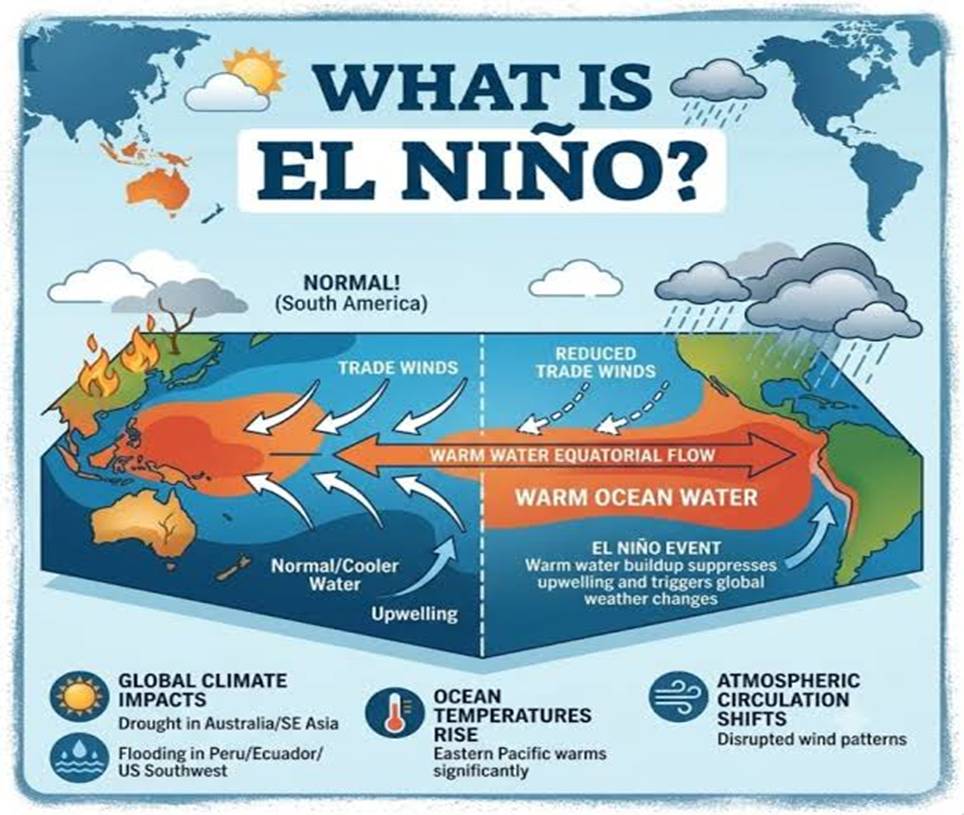
Into this backdrop of rising temperatures come an El Nino event. “El Nino” is a periodic weather disturbance in the Pacific in which warm water builds up in the eastern Pacific off the coast of Peru. This plume of warm water releases its heat into the atmosphere, and the result is almost always a spike in global temperatures. But not only do temperatures rise above baseline, there are certain common weather events around the globe. Southern California and the American West usually see very high rainfall and snow during an El Nino year. This will be welcome in a part of the US that has experienced drought for a long time. But Indonesia often gets a very dry monsoon, and the Indian and African monsoons weaken and fail to discharge as much rain as normal.
What makes the future even more concerning is that as El Ninos go, this is one for the record books. The amount of heat in Eastern Pacific is far above that seen in any El Nino in the records. Will this mean that Earth’s temperature will spike to a new high? Almost certainly. We will clearly breach the 1.5 degrees centigrade limit, and some scientists are speculating that we could reach 2 degrees. 2027 is shaping up to be a hot year that surpasses 2025 and every year before.
The UN and the IPCC established keeping global warming to substantially less than 2 degrees to be the goal of global climate policy. That is still possible even if we have a single year spike of over 2 degrees due to El Nino. When El Nino subsides the Earth’s temperature will go back down, but probably not to where it was before. The underlying trend remains up.
Knowing all this, it is imperative for the nations of the world to move to a zero or near zero emission energy system as soon as possible. While the news on the climate front is bad, the news on the technology front is actually quite good. Solar power has become incredibly cheap and is expanding at a phenomenal pace. Solar accounts for over 70% of new electricity generation capacity in 2025, and provides about 9% of global electricity. Wind also provides another 9%. Hydro provides 14% and nuclear another 8%. Overall, 40% of the globe’s electricity supply is now zero emission. On the vehicle side, 20 million cars sold last year were electric or plug-in hybrid, making up 25% of all cars sold. That share is rising rapidly, and cheap Chinese electric vehicles are selling all around the world, though not in the US due to import restrictions.
Solar and wind are great, but they don’t work at night or when the winds are calm. The solution to that is batteries, which are plunging in price and also showing rapid rise in global sales. The question is whether we can get our emissions down to near zero before the Earth’s temperature rises too much for comfort. Melting glaciers in the Himalayas, droughts, heat waves, shrinking polar sea ice, and overheating coral reefs are just some of the issues global warming will worsen.
Technology does offer another solution to manage the heat. We can artificially cool the Earth by injecting large amounts of sulfur dioxide gas into the stratosphere, located above 20,000 feet in altitude. This could be done via planes or balloons. The sulfur dioxide reacts to form tiny sulfate aerosols that scatter incoming sunlight back into space and reduce the amount of solar radiation reaching the Earth’s surface. This is not merely a hypothetical reduction. Large volcanic eruptions spew sulfur dioxide into the stratosphere and cool the Earth. The last such eruption, Mount Pinatubo in the Philippines in 1991, cooled the Earth by 0.5 degrees centigrade and the effect lasted a year until the sulfur slowly fell out of the sky. This process, known as solar radiation management (SRM) has been proposed as a last defense against climate change. But it is not a substitute for getting to zero emissions. Based on current trends we will probably reach zero emissions around 2050 or 2060.
After we get to zero, we could also reverse the process. It is very expensive, but it is possible to pull carbon dioxide out of the atmosphere and push it into deep underground storage. Oil companies use carbon dioxide injection to improve recovery of oil from their wells already. It is time to start investing in developing the technology of “carbon capture and storage” (CCS). If we invest over the next few decades in getting that technology mature and cheap enough, we could literally reverse global warming. At 200 dollars/ton, we could sequester a billion tons of carbon dioxide for 200 billion dollars. To sequester 10 billion tons would cost 2 trillion dollars. That seems like an impossible amount of money, but global GDP is 125 trillion dollars in 2025. What will it be in 2070? Likely 500 trillion dollars, so spending 2 trillion then would be easily managed. Lots of countries spend 3-5% of their GDP on defense, why couldn’t we spend half of that on climate change?